The end of owning a super yacht?
A shift is happening in the world of the ultra-rich. The focus is moving away from owning luxury assets towards buying exclusive experiences. This change has major implications for the super yacht market, affecting both yacht sales and the charter business. Based on recent articles from The Economist and the Dutch financial newspaper Het Financieele Dagblad, we will explore what this trend means for the industry.
The core of this transformation is a change in what the ultra-wealthy value. It is no longer just about owning expensive things. Instead, status is now increasingly defined by exclusive, private, and unique experiences. This article will analyse how this shift could harm super yacht sales but create new opportunities for the crewed charter market.
From Possessions to Experiences
Both The Economist and Het Financieele Dagblad report on a significant trend: the ultra-wealthy are choosing experiences over physical assets. According to The Economist, an index measuring the value of luxury investments like art, wine, and property has fallen by 6% from its 2023 peak. In contrast, an index for ultra-luxury services has grown by 90% since 2019. Het Financieele Dagblad confirms this, noting that the luxury goods market is shrinking, while the market for ultra-luxury services is expanding rapidly.
This shift is rooted in a new understanding of what makes something exclusive. The economist Thorstein Veblen’s principles of scarcity and rivalrousness, mentioned in The Economist, suggest that luxury is no longer just about possessing rare items. As social media makes luxury goods more visible, their exclusivity diminishes. The new status symbols are privacy and experiences that cannot be easily shared or replicated online.
The Challenge for Super Yacht Sales
The move away from ownership-based luxury presents a significant challenge for super yacht sales. Super yachts are the kind of tangible, high-value assets that are becoming less appealing to the modern ultra-wealthy individual.
Several factors contribute to this decline:
- Democratisation of Access: Luxury loses its appeal when it becomes too accessible. The Economist points to the decline in private jet chartering as an example. Super yacht charters have also made the experience of being on a super yacht available without the need for ownership. If the ultra-wealthy can enjoy the same lifestyle through chartering, the motivation to buy a multi-million-pound vessel decreases.
- Social Media Saturation: Het Financieele Dagblad highlights that items displayed on social media lose their exclusive feel. The constant stream of images from glamorous yacht charters makes the asset class seem more common. True status now comes from privacy, not from public displays of wealth.
- A New Definition of Status: The Dutch newspaper also notes that ownership is becoming “passé”, and privacy is the new ultimate luxury. A super yacht is a very visible asset that attracts public and media attention. This is the opposite of the new desire for private, offline experiences like silent retreats or exclusive dinners where phones are not allowed.
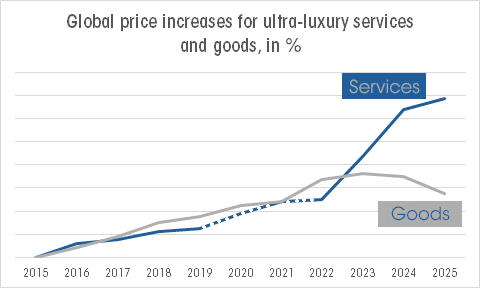
Source : Het Financieele Dagblad (based on the graph from the Economist) – no data for 2020-2021
An Opportunity for Crewed Charters
While yacht sales may face challenges, the crewed charter sector stands to benefit. Chartering is a service-based model, which aligns perfectly with the growing demand for exclusive experiences.
Here is why crewed charters are well-positioned for growth:
- The Ultimate Experience: A crewed charter is about a curated, time-limited experience, not ownership. It offers what The Economist describes as the ultimate luxury: “the knowledge that, for those few hours, nobody else on Earth could sit at your table.” A private charter provides this sense of temporary, unmatched exclusivity.
- Premium Pricing Potential: The articles show that ultra-luxury services can command higher prices because they are scarce. Just as salaries for high-end housekeepers have risen, charter operators can justify higher rates. Their services are part of the expanding ultra-luxury service market, not the contracting luxury goods market.
- Tailored Exclusivity and Privacy: The charter model is ideal for delivering the privacy that the ultra-wealthy now seek. A charter can be customised to offer complete solitude, unique destinations, and bespoke experiences. This is often more exclusive than owning a yacht, which comes with the complexities of crew and maintenance.
- Offline and Temporary by Design: Crewed charters fit the description of experiences that are “exclusive, temporary, and preferably offline,” as noted by both publications. The charter industry can market these features directly to clients who want to disconnect and enjoy a private escape.
A Divided Future for the Super Yacht Market
The analysis suggests that the super yacht market is splitting. The market for yacht ownership, driven by the desire for status through possession, is likely to shrink. However, crewed charter operations that position themselves as providers of premium experiences should do well.
For yacht companies, the key will be to shift their focus from selling assets to providing experiences. A broker selling a £150 million yacht as a status symbol will face difficulties. In contrast, a charter operator offering a unique Arctic expedition with a world-class crew and total privacy is tapping into the 90% growth of the ultra-luxury services market.
The future of the super yacht industry depends on adapting to this new definition of luxury. The companies that understand and cater to the demand for exclusive, private, and memorable experiences will be the ones that succeed.