The WWII blockade runner hidden in a €30 tonnage certificate
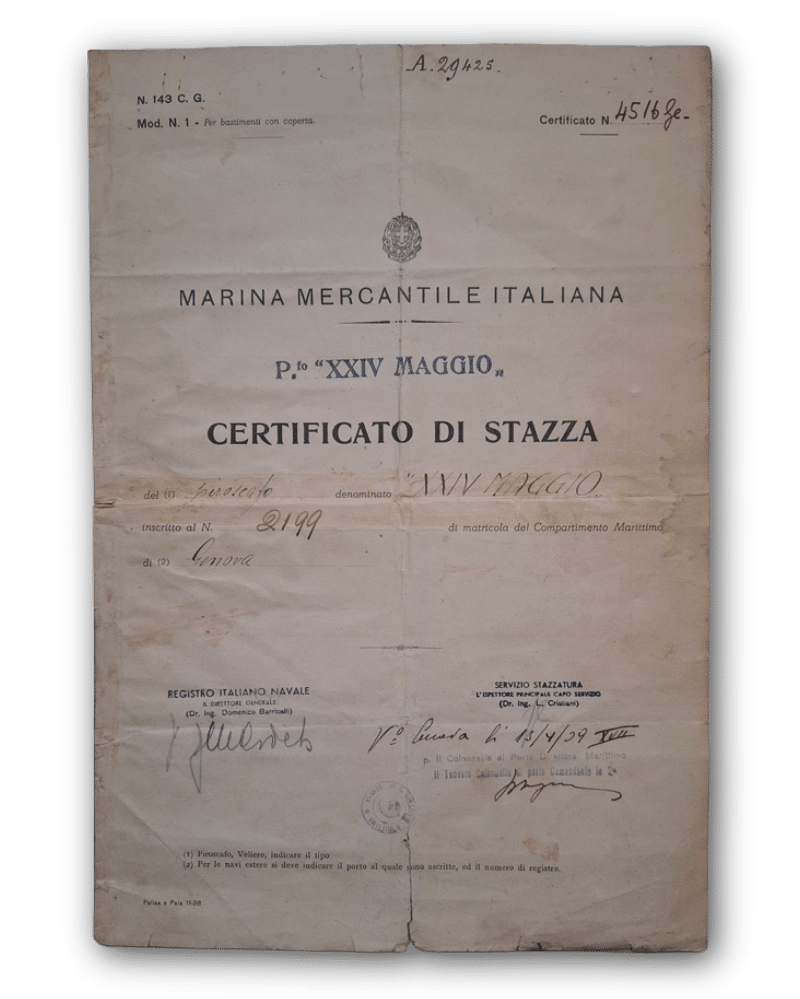
I recently purchased the Tonnage Certificate of the steamship XXIV MAGGIO at an auction for just over €30. When the envelope arrived from Italy, the document inside had been folded to roughly the size of a postcard. It was slightly stained, torn on the creases, and bore traces of old adhesive tape. To the untrained eye, it looked like just another piece of discarded administrative paperwork. However, unfolding this 32 by 44-centimetre certificate revealed a fascinating window into a turbulent era of maritime history.
As a vessel owner, you are likely very familiar with the mountain of paperwork that comes with vessel ownership. From registration documents to insurance certificates, managing a boat requires a dedicated approach to administration. But have you ever stopped to think about the stories those documents hold? Every vessel has a history, and the paperwork left behind acts as a physical timeline of its journey.
The story of the XXIV MAGGIO is particularly gripping. It involves a visionary sea captain, a worker-owned shipping cooperative, and a highly dangerous blockade run across the Atlantic Ocean during the Second World War. By examining this single document, we can piece together a remarkable maritime adventure.
Decoding a piece of maritime history
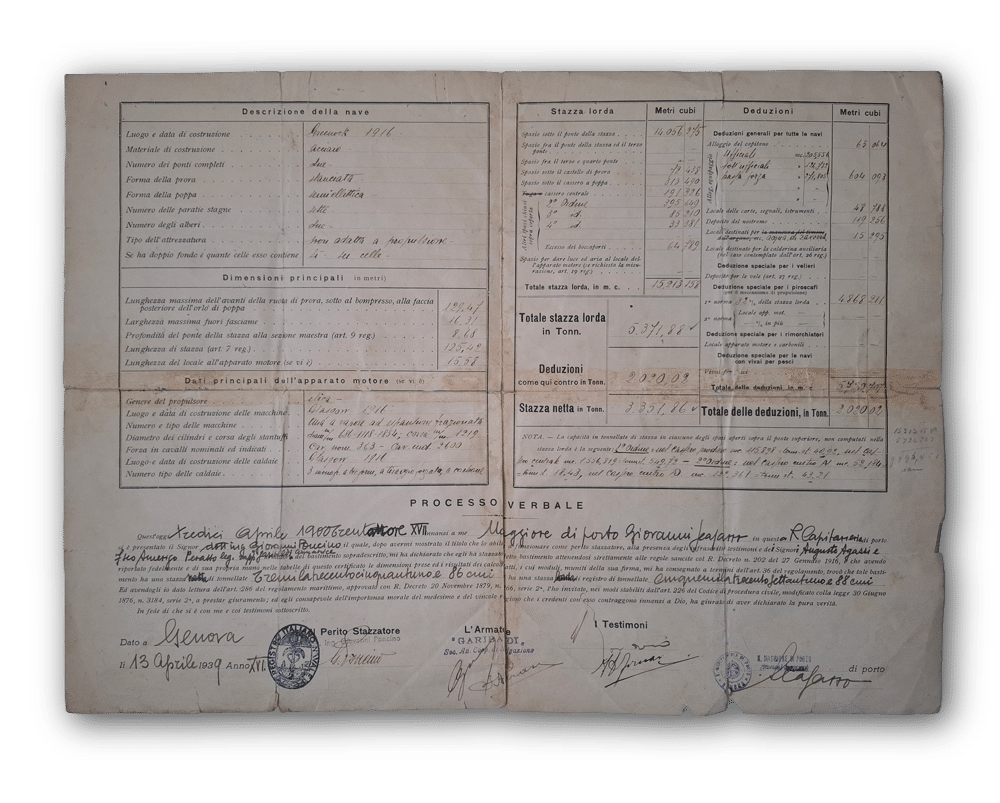
Translating the 1939 Italian certificate into English was quite a challenge, as the handwritten notes were faded and difficult to read. It appears that at least two different people filled in the form, as there are two distinct handwriting styles and ink colours detectable on the page.
The certificate was issued in Genoa on the 13th of April 1939. It was signed by the Tonnage Surveyor, Engineer Giovanni Poncino, and the Maritime Director, Dr. Engineer Domenico Barricelli. According to the data meticulously recorded in the tables, the XXIV MAGGIO was a steel-hulled cargo steamship featuring two complete decks, two masts, a slender bow, and a semi-elliptical stern.
The main dimensions of the vessel were impressive for its time. It had a maximum length of 129.47 metres and a maximum width of 16.31 metres. The gross tonnage was calculated at exactly 5,371.88 tons, while the net tonnage came in at 3,351.86 tons. For those who are newer to maritime terminology, gross tonnage measures the overall internal volume of a ship, while net tonnage measures the useful capacity for cargo or passengers. Think of it like buying a house; the gross tonnage is the total square footage including the walls and attic, while the net tonnage is the actual living space you can use.
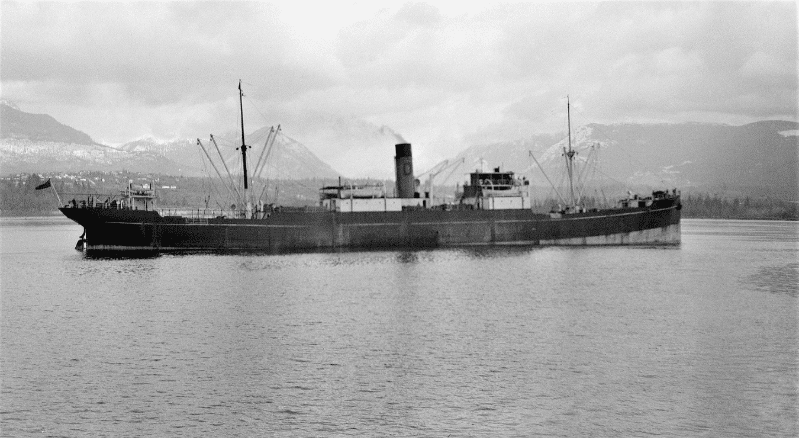
Source : Caledonian Maritime Research Trust
Image courtesy of : City of Vancouver Archives
The many lives of a steel cargo ship
Before the ship became the XXIV MAGGIO, it sailed under several different names and flags. It was originally built in 1916 by the Greenock and Grangemouth Dockyard Company in Scotland. It started its life as the Gogovale for a Glasgow-based company, before being renamed the Pennyworth. Under British ownership, it survived being torpedoed in 1918 and endured a major grounding on the St. Lawrence River in 1933. It later passed through Yugoslav and Canadian ownership under the names Orao and Pontbriand.
In 1937, the vessel was purchased by its final owner, the Società Anonima Cooperativa di Navigazione Garibaldi. They registered the ship in Genoa and gave it the name XXIV MAGGIO. This name was a deeply symbolic patriotic reference to the 24th of May 1915, the date Italy entered the First World War.
The extraordinary life of Captain Giulietti
To fully understand the history of this ship, we must look at the company that bought it. The Cooperativa Garibaldi was founded on the 18th of September 1918 aboard the ocean liner Giuseppe Verdi. It was the brainchild of Captain Giuseppe Giulietti, an extraordinary mariner and trade union activist.
Giulietti was born into a poor fishing family but worked his way up from cabin boy to captain. He firmly believed that maritime workers of all ranks should unite. His rallying slogan was “from captain to cabin boy”, illustrating his vision of a fair and unified maritime industry. The cooperative was a genuinely unusual institution in Italian maritime history. It was a worker-owned and worker-managed shipping cooperative that operated commercially viable ocean-going vessels alongside the large, privately owned shipping lines.
Operating a worker-owned cooperative during the rise of the Fascist regime in Italy was an incredibly difficult balancing act. Giulietti had to navigate a politically hostile environment to keep the cooperative functioning and to protect the livelihoods of his seafaring members. The cooperative survived the regime, proving the resilience of the organisation Giulietti had built.
The great blockade run of 1941
The most dramatic chapter in the life of the XXIV MAGGIO occurred during the Second World War. When Italy entered the war on the 10th of June 1940, the ship was sitting in the port of Recife, Brazil. Suddenly, the vessel was stranded in a neutral port, unable to return home through waters heavily monitored by the Allied naval blockade.
After sitting inactive for a year, a dangerous plan was formulated. The Italian Naval Staff ordered merchant ships sheltering in neutral ports to run the blockade and sail to Bordeaux in occupied France. The ships were heavily loaded with raw materials that were desperately needed for the war effort.
On the night of the 29th of June 1941, the XXIV MAGGIO departed Recife with 40 men on board. The cargo holds were packed with 996 tonnes of mixed goods, including 406 tonnes of cotton, 218 tonnes of rubber, 207 tonnes of beryllium, and 165 tonnes of hides.
To evade capture, the crew disguised the XXIV MAGGIO to look like a British steamship named the Australind. It was a high-stakes game of hide and seek across the Atlantic Ocean. To prevent a tragic friendly-fire incident, the Italian submarine command sent urgent messages to all their submarines, identifying the disguise so the XXIV MAGGIO would not be accidentally torpedoed by its own forces.
Against all odds, the ship successfully completed its hazardous ocean crossing and reached Bordeaux, delivering its vital cargo. The vessel, however, did not survive the war. Following the Italian armistice in 1943, the XXIV MAGGIO was seized by German forces. On 22 September 1944, it was scuttled by the Germans in Amsterdam to block the port. After the war, the wreck was recovered and subsequently dismantled.
Preserving your own maritime heritage
It is fascinating how a simple piece of folded paper can hold such a vast and complex history. The Tonnage Certificate of the XXIV MAGGIO is more than just a list of measurements; it is a tangible connection to a bygone era of brave sailors and treacherous ocean crossings.
While the paperwork for your own yacht might not feature wartime espionage or blockade runs, it is still an essential part of your vessel’s story. Keeping your registration, safety certificates, and maintenance records well organised ensures a seamless and compliant ownership experience.