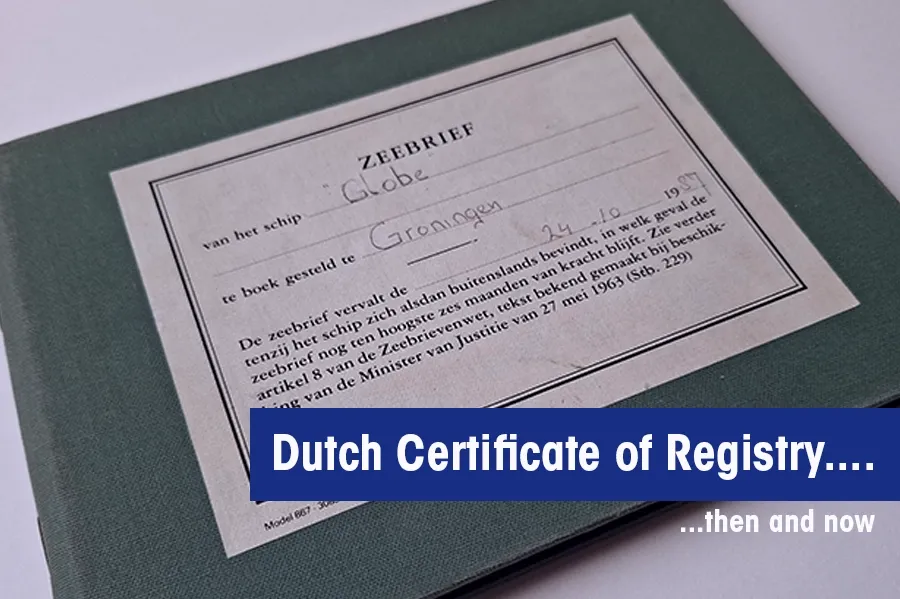
The 1983 Zeebrief of the cargo ship GLOBE: a Dutch Certificate of Registry, then and now
This article compares two Dutch Certificates of Registry (Zeebrief). The first was issued on 24 October 1983 to the cargo ship GLOBE of Groningen: a green linen booklet, filled in by hand. The second is the certificate the Netherlands issues today: three A4 pages, on paper or as a PDF. Both do the same job, and they could hardly look more different.
We work with Certificates of Registry every day, and most of them arrive as a PDF in our inbox. So when the GLOBE’s booklet landed on our desk, we stopped what we were doing and opened it. Let us open it together.
The cover of the 1983 Zeebrief: green linen and a handwritten label
The cover is green linen, 21 by 15 cm, about the size of a paperback. A paper label on the front gives the ship’s name, “Globe”, in neat handwriting. Below it are the port of registry, Groningen, and an expiry date: 24 October 1987.
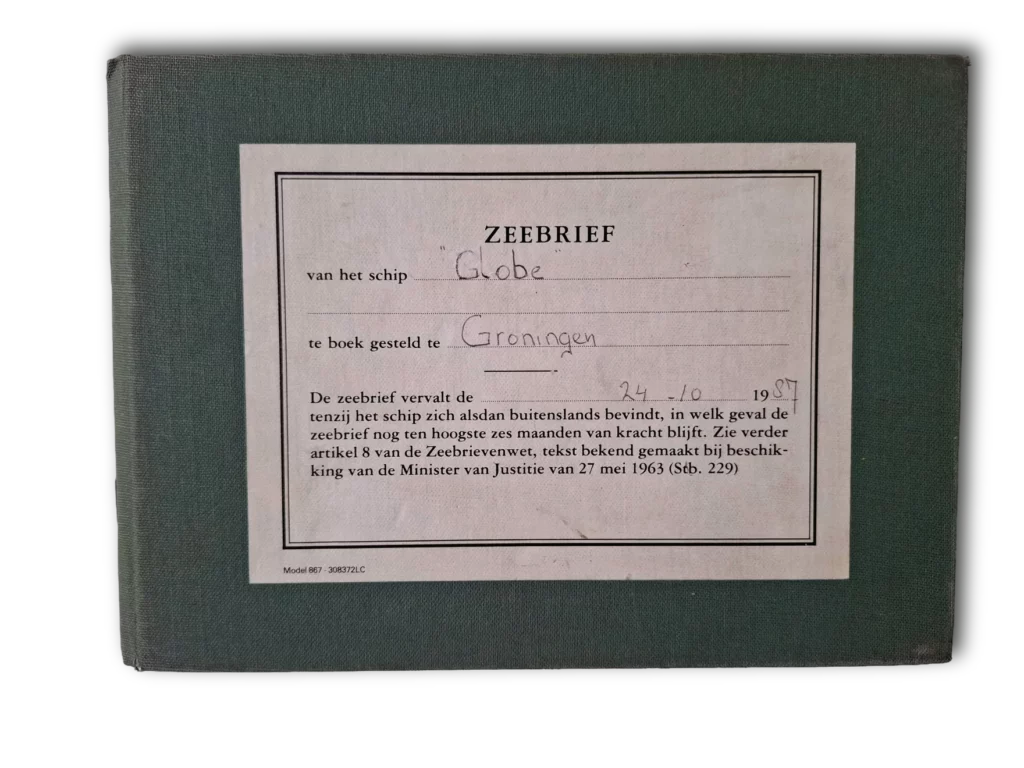
The label also carries a small rule in print. If the ship is abroad on the expiry date, the certificate stays valid for at most six more months. Nobody wanted a ship to lose her nationality halfway across the North Sea.
Inside the booklet: a certificate made for life on board
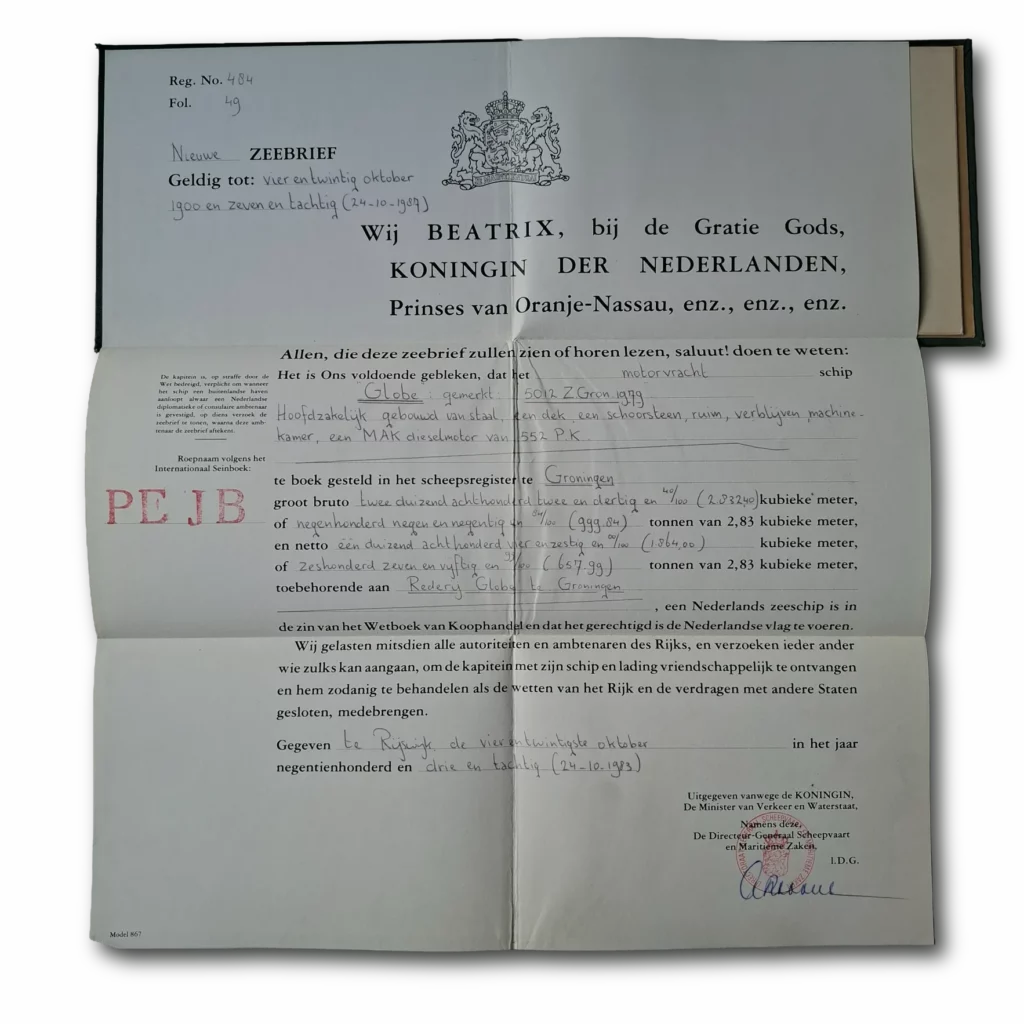
Open the cover, and a folded sheet sits on the left. Unfold it carefully. It measures 43 by 38.7 cm, larger than an A3 page, and it does not feel like paper. It is a kind of artificial parchment, thick and smooth, and it resists moisture. For a document that lives on a ship, that is a sensible choice.
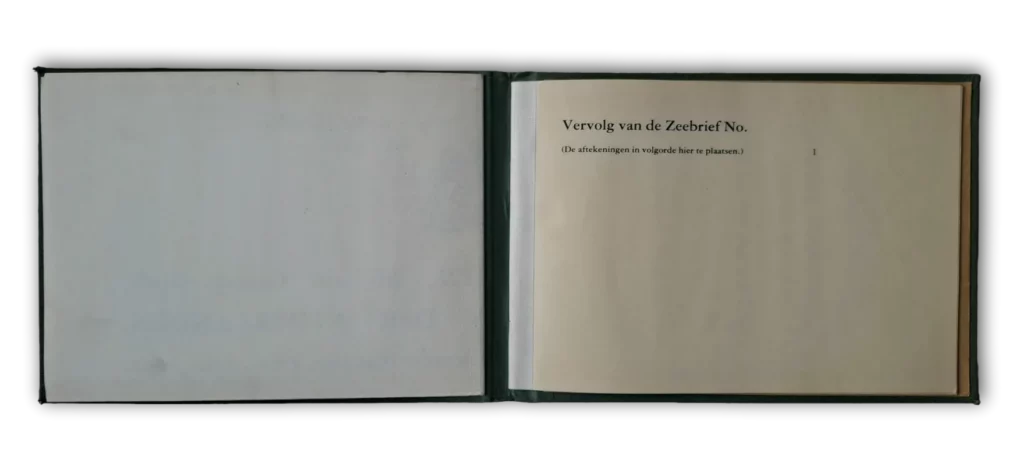
On the right are eight numbered pages, each headed “Vervolg van de Zeebrief No.” (continuation of the Zeebrief). They are meant for Dutch consuls and diplomats in foreign ports. A note in the margin of the certificate warns the captain: when such an official asks to see the certificate, he must show it, or the law threatens a penalty. The official then signs one of these pages. In theory, the booklet could become a travel diary with official stamps from every port.
On this copy, all eight pages are empty.
The text of the certificate: a royal voice and a cheerful “saluut!”
Then there is the text, and it begins with a royal voice. Queen Beatrix speaks in person: “Wij BEATRIX, bij de Gratie Gods, KONINGIN DER NEDERLANDEN, Prinses van Oranje-Nassau, enz., enz., enz.” The three times “etc.” stand for the rest of her titles, which the certificate politely leaves out. Next, the Queen greets everyone who will see this certificate, or hear it read aloud, with a cheerful “saluut!”. It is not every day that a government form says hello.
After the greeting comes the business. The Queen declares that the motor cargo ship Globe, owned by Rederij Globe in Groningen, is a Dutch seagoing ship and may fly the Dutch flag.
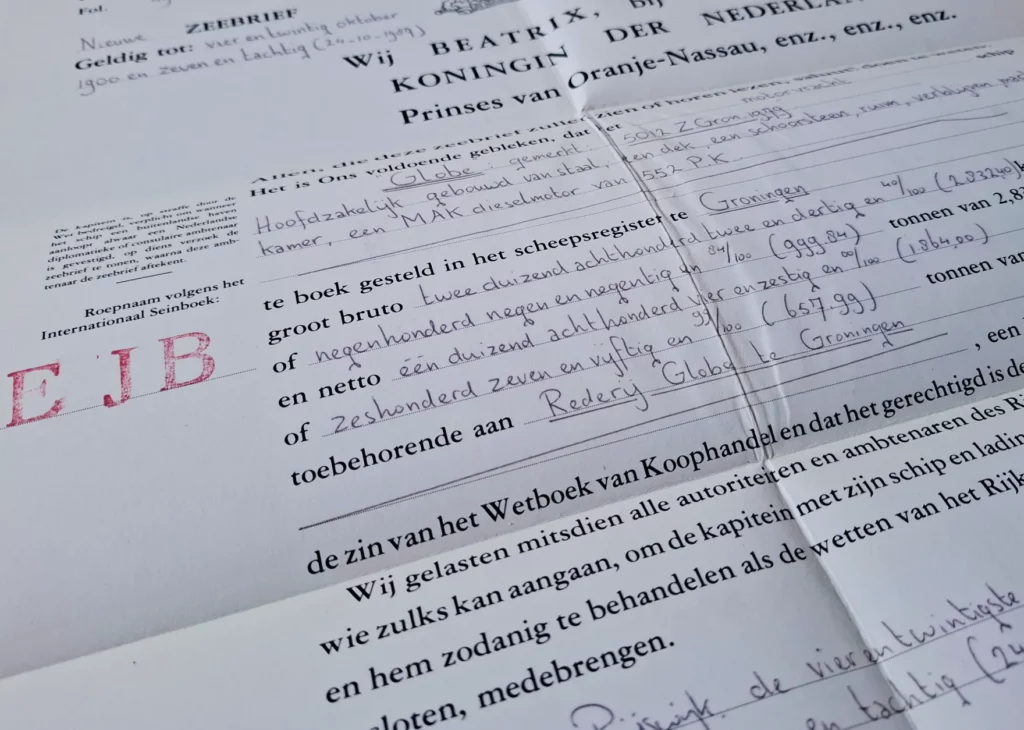
All the details are filled in by hand, in ink, and every number appears twice: once in words and once in figures. Take the gross tonnage: “twee duizend achthonderd twee en dertig en 40/100 (2.832,40) kubieke meter”. The expiry date became “vierentwintig oktober 1900 en zeven en tachtig”, with the century in figures and the rest in words. We suspect it had been a long day at the office.
In the margin, the ship’s call sign, PE JB, is stamped in red. At the bottom, the certificate was signed in Rijswijk on 24 October 1983, for the Minister of Transport and Water Management, on behalf of the Director-General of Shipping and Maritime Affairs. A stamp sits next to the signature.
Three details in the 1983 certificate
Read the certificate slowly, and three lines start to tell their own small stories.
The official number: chiselled before the ship had a name
The certificate describes the ship as “gemerkt: 5012 Z GRON 1979”. This is her official number. On 3 August 1979, two months before her launch, it was chiselled into the steel of her stern. At that moment, the ship did not have a name yet. For a while, she was a number in steel and nothing more. A paper certificate can be lost. A number in steel stays where it is.
Engine power: 552 horses that were really kilowatts
The engine is described as “een MAK dieselmotor van 552 P.K.”. P.K. is the Dutch abbreviation for horsepower. But the engine produced 750 hp, which is 552 kW. Somebody wrote the kilowatt figure with the horsepower unit. So on paper, the GLOBE lost 198 horses. At sea, the engine did not notice.
Tonnage: measured in cubic metres and register tons
On this certificate, a ton is not a weight. It is a space. In 1983, the size of a ship was measured by how much room there is inside her, not by how heavy she is.
The measurer counted that room in cubic metres. A cubic metre is a box one metre long, one metre wide and one metre high. He then converted the cubic metres into register tons. One register ton is 100 cubic feet, or 2.83 cubic metres: a box of about 1.41 metres on each side.
For the GLOBE, that gives two figures:
- Gross tonnage, all the enclosed space on board: 2,832.40 cubic metres, or 999.84 register tons.
- Net tonnage, only the space that earns money, mainly the cargo holds: 1,864.01 cubic metres, or 657.99 register tons.
So the GLOBE “weighed” 999.84 tons, and nobody ever put her on a scale.
The closing paragraph: a royal request to receive the captain
Our favourite part comes at the end. The certificate closes with this paragraph:
“Wij gelasten mitsdien alle autoriteiten en ambtenaren des Rijks, en verzoeken ieder ander wie zulks kan aangaan, om de kapitein met zijn schip en lading vriendschappelijk te ontvangen en hem zodanig te behandelen als de wetten van het Rijk en de verdragen met andere Staten gesloten, medebrengen.”
In English: the Queen orders all authorities and officials of the Kingdom, and asks everyone else concerned, to receive the captain, his ship and his cargo in a friendly way. They should treat him as the laws of the Kingdom and its treaties with other states require.
Note the two verbs. The Queen orders her own officials, but she only asks the rest of the world. It is the one part of the certificate that speaks to the people in the next port, and it does so with good manners.
The Dutch Certificate of Registry today: 1983 and now compared
Now put the booklet down and pick up today’s Dutch Certificate of Registry. It has the same legal function, but very little else in common. For the comparison, we use a sample of the provisional version (Voorlopige Zeebrief, form ZVJAC of 11 August 2021).
| GLOBE, 1983 | Today | |
|---|---|---|
| Form | Linen-bound booklet | Three A4 pages, on paper or as a PDF |
| Material | Artificial parchment | Paper with a printed security pattern |
| Size of the certificate | 43 x 38.7 cm, folded | 21 x 29.7 cm per page |
| Language | Dutch only | Dutch, with an English line in small italics below each Dutch line |
| Opening | “Wij BEATRIX, bij de Gratie Gods…” | “In naam van Zijne Majesteit de Koning der Nederlanden” |
| Legal basis | Zeebrievenwet | Rijkswet nationaliteit zeeschepen (2023) |
| Engine power | In P.K. (horsepower) | In kW |
| Tonnage | Cubic metres and register tons | Gross and net tonnage, without a unit, under the 1969 International Tonnage Convention |
| Details filled in | By hand, in ink | Printed |
| Signed for | Director-General of Shipping and Maritime Affairs | Head of Communications, Services and Licensing |
| Space for consular endorsements | Eight numbered pages | One page |
| Closing request to receive the captain | Yes | No |
Some things have not changed at all. The certificate still states that the ship is a Dutch seagoing vessel within the meaning of the Commercial Code, and that she may fly the Dutch flag. That sentence is almost word for word the same as in 1983. And a Dutch consul abroad can still sign it, on page 3.
Other things have gone. The Queen no longer speaks in person: the King’s name appears at the top, and the form does the talking. The friendly request at the end has disappeared too. We have not found it on any current certificate, from the Netherlands or from the other flag states we work with.
Modern Certificates of Registry are printed on paper or issued as a PDF. Not all registries issue a PDF. Either way, they are quick to issue, easy to check and easy to print again. We would not want to go back to filling in every number twice. But put the two side by side, and only one of them looks and feels like a certificate.
What became of the GLOBE
The certificate expired on 24 October 1987, but the ship kept going. She was built by N.V. Scheepswerf ‘Delfzijl’ v/h Gebr. Sander, launched on 6 October 1979 and delivered on 1 November 1979 to Rederij Globe in Groningen. Since then, she has changed her name three times and her flag three times:
| Year | Name | Flag |
|---|---|---|
| 1979 | GLOBE | Netherlands |
| 1993 | ROCKFLEET | Ireland |
| 2000 | CLONLEE | Ireland |
| 2003 | GLOBIA | St Vincent and the Grenadines |
| 2024 | GLOBIA | Guyana |
At the time of writing, 47 years after her launch, she is still in service. Her first certificate stayed behind in its green booklet, still asking the world, in Dutch, to receive her captain in a friendly way.
From linen booklet to PDF
Do you have an old Certificate of Registry in a drawer? We would love to see it. And if you need a new one, on paper or as a PDF, do drop us a note. We are here to help.
Sources
- The 1983 Zeebrief of the GLOBE, private collection
- Sample of the current Dutch provisional Certificate of Registry (Voorlopige Zeebrief), form ZVJAC of 11 August 2021
- Maritiem-Historische Databank: GLOBE