The Dragon Bleu: A Trawler, Four Mortgages, and a Mystery in Blue Ink
Picture a busy port in post-war Bordeaux. The smell of diesel and salt water hangs in the air. The war is over, but the rebuilding has barely begun. And somewhere in a customs office, a civil servant sits at a desk, uncaps a fountain pen, and begins to write.
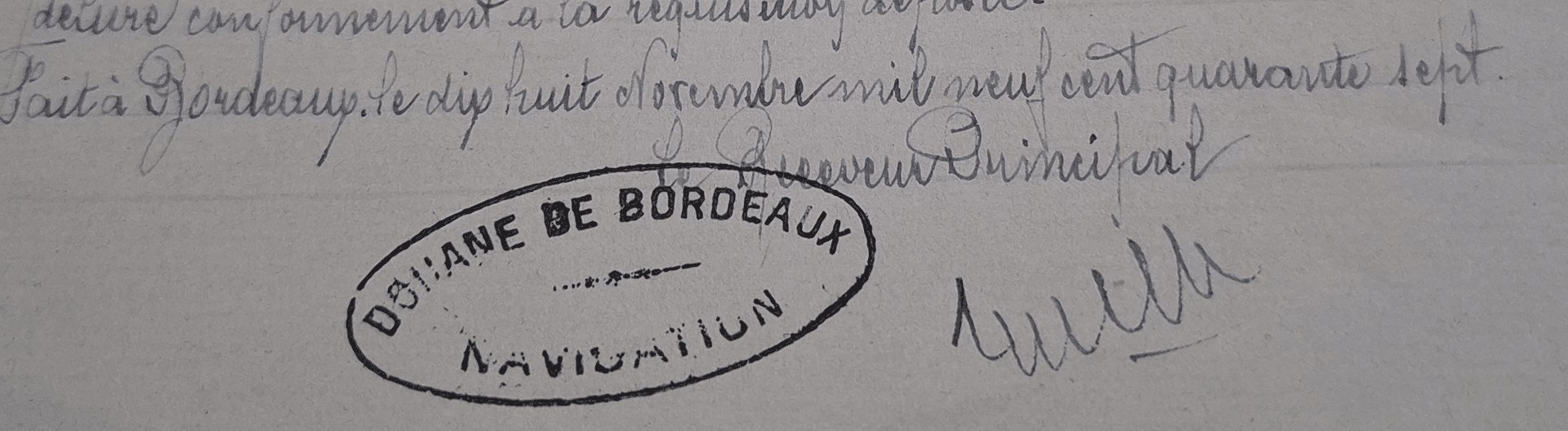
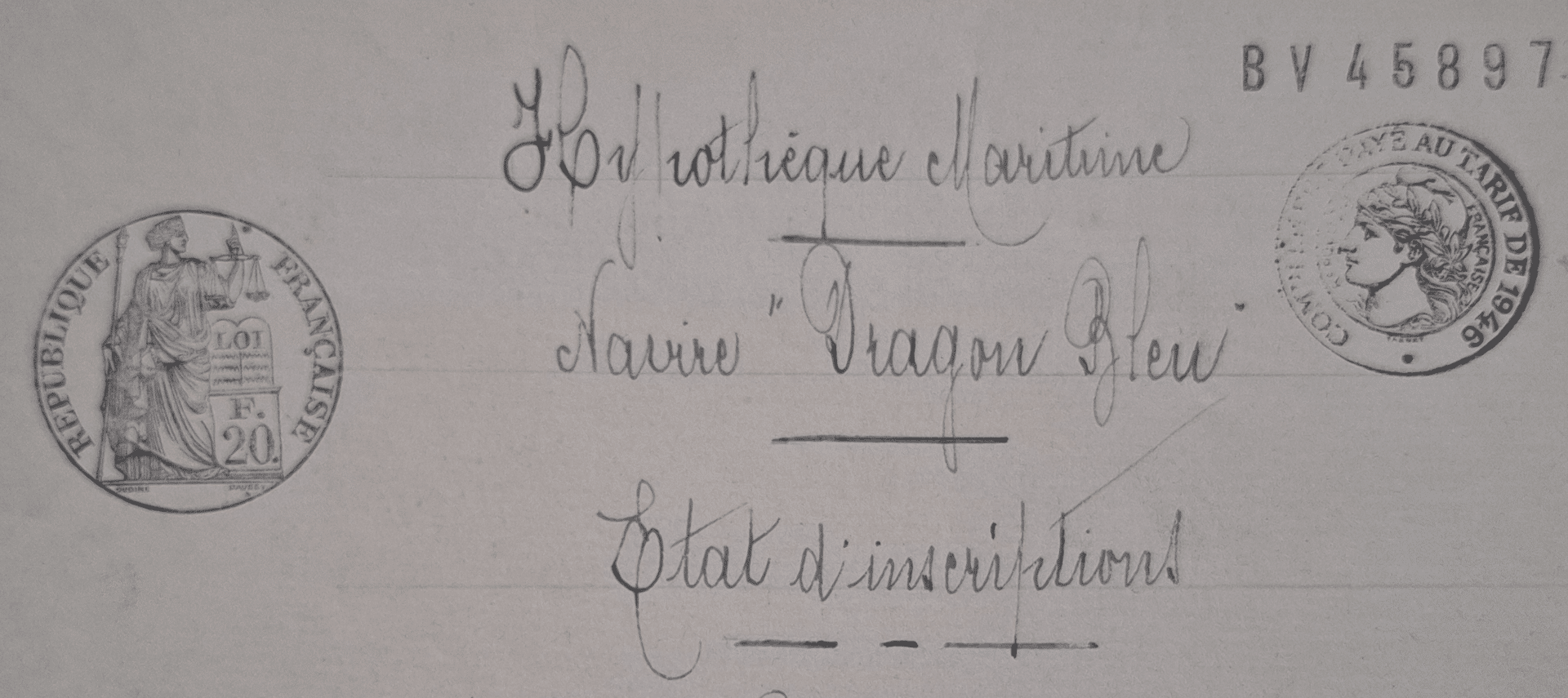
What follows is a remarkable document, a handwritten extract from the French maritime mortgage register, issued on 17 November 1947, outlining the financial encumbrances on a steam trawler called “Dragon Bleu.” It is a window into post-war maritime finance, the world of French fishing vessels, and the occasionally precarious business of being an armateur.
What is a Maritime Mortgage Register, and Why Does it Exist?
Before getting into the details of the Dragon Bleu’s financial situation, it is worth pausing to explain what this document actually is, and why it matters.
A maritime mortgage register (in French: registre des hypothèques maritimes) is an official record maintained by the customs authority (Douanes) of a country, in which all financial claims secured against a vessel are formally noted. Much like a land registry records a mortgage on a house, the maritime mortgage register records loans and credit facilities secured against a ship.
The logic is simple: a vessel is a valuable asset, and lenders want protection. If the owner cannot repay a loan, the lender needs the right to seize the ship and sell it to recover the money. The mortgage register makes those claims public and legally binding.
In France, this system dates back to the Napoleonic era and remains in use today, though the process has been modernised considerably. The document now exists as a digital record accessible online through the French customs administration, a far cry from the handwritten pages of 1947. Back then, if you wanted to know whether a vessel was mortgaged, you visited the local customs office, made a formal request, and waited while a clerk searched the register by hand and produced a certified extract.
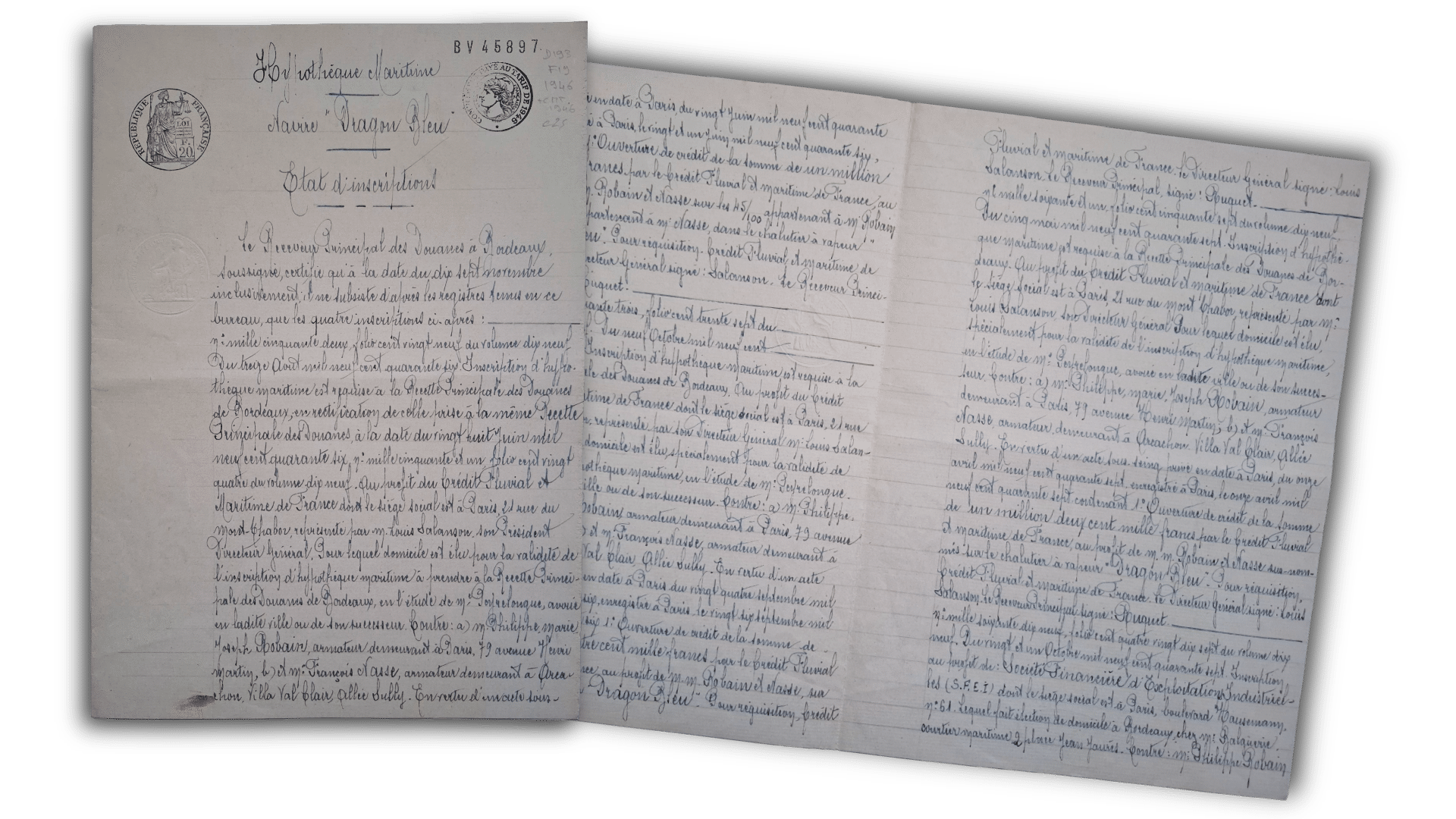
That is precisely what this document is: a certified “état d’inscriptions” – a statement of inscriptions – confirming every mortgage recorded against the Dragon Bleu as of 17 November 1947.
A Document Worth Examining Closely
The physical document itself is striking. It is written entirely by hand, in careful, elegant script using a blue fountain pen. Given that the typewriter was already a commonplace office tool by 1947, the choice to write this document by hand is curious. One possible explanation is tradition: formal legal and administrative documents in France were historically handwritten, and some offices were simply slow to change their habits. Another is practicality: handwriting allowed for corrections, insertions, and careful spacing that early typewriters made awkward when dealing with tabular legal text.
What makes it even more interesting is the signature at the end, written in a noticeably different shade of blue ink. It is a small but telling detail. Almost certainly, the document was drafted by a clerk, then signed by a superior officer – the Receveur principal des Douanes – using a different pen. A mundane explanation, perhaps, but it gives the document a layered, human quality. Two different hands. Two different pens. A single official act.
And the time it must have taken. A document of this complexity, listing four separate mortgage inscriptions, each with dates, reference numbers, creditor names, debtor addresses, and financial amounts, would have taken at least an hour to write out cleanly, possibly longer if earlier drafts were required. This was skilled administrative work, and it shows.
The Dragon Bleu and Her Owners
The vessel at the centre of this document is the Dragon Bleu, a steam trawler (chalutier à vapeur) with a tonnage of approximately 894 tonnes, registered under a francisation act issued by the French Ministry of Finance on 20 January 1938. Francisation is the French process of officially registering a vessel under the French flag, roughly equivalent to registration in other jurisdictions.
The ship is co-owned by two armateurs: Philippe Marie Joseph Robain, residing in Paris at 79 avenue Henri-Martin, and François Classe, residing in Arcachon at Villa Val Clair, allée Sully. An armateur, in French maritime law, is not simply an owner, it is someone who equips and operates a vessel commercially, taking on both the financial risk and the responsibility of running the ship. The term sits somewhere between “shipowner” and “shipping operator.”
Robain holds a 45/100 share in the vessel; Classe holds 20/100. The remaining 35/100 is not accounted for in this document, which means there is at least one additional co-owner whose shares are not directly encumbered by the mortgages listed here, or whose share details were simply not relevant to the inscriptions being recorded.
Philippe Robain is also described in the fourth inscription as a capitaine au long cours – a deep-sea captain – which suggests he was not merely a passive investor but someone with genuine seafaring credentials. An owner-operator, in modern terms.
Four Mortgages in Fourteen Months
The document records four mortgage inscriptions registered against the Dragon Bleu between August 1946 and October 1947, a remarkably busy period of borrowing for a single vessel.
The first three mortgages are all in favour of the same lender: Crédit Fluvial et Maritime de France, a Paris-based institution whose name suggests a specialisation in river and maritime finance. Each inscription secures a separate “opening of credit” – effectively a line of credit rather than a fixed loan – granted to Robain and Classe against their respective shares in the trawler.
- August 1946: 1,100,000 francs (€167.693,91)
- October 1946: 1,400,000 francs (€213.428,62)
- May 1947: 1,200,000 francs (€182.938,82)
Together, these three facilities total 3,700,000 francs (€564.061,36) – a substantial sum, though not enormous by the standards of post-war reconstruction finance.
Then comes the fourth inscription, and the tone shifts considerably.
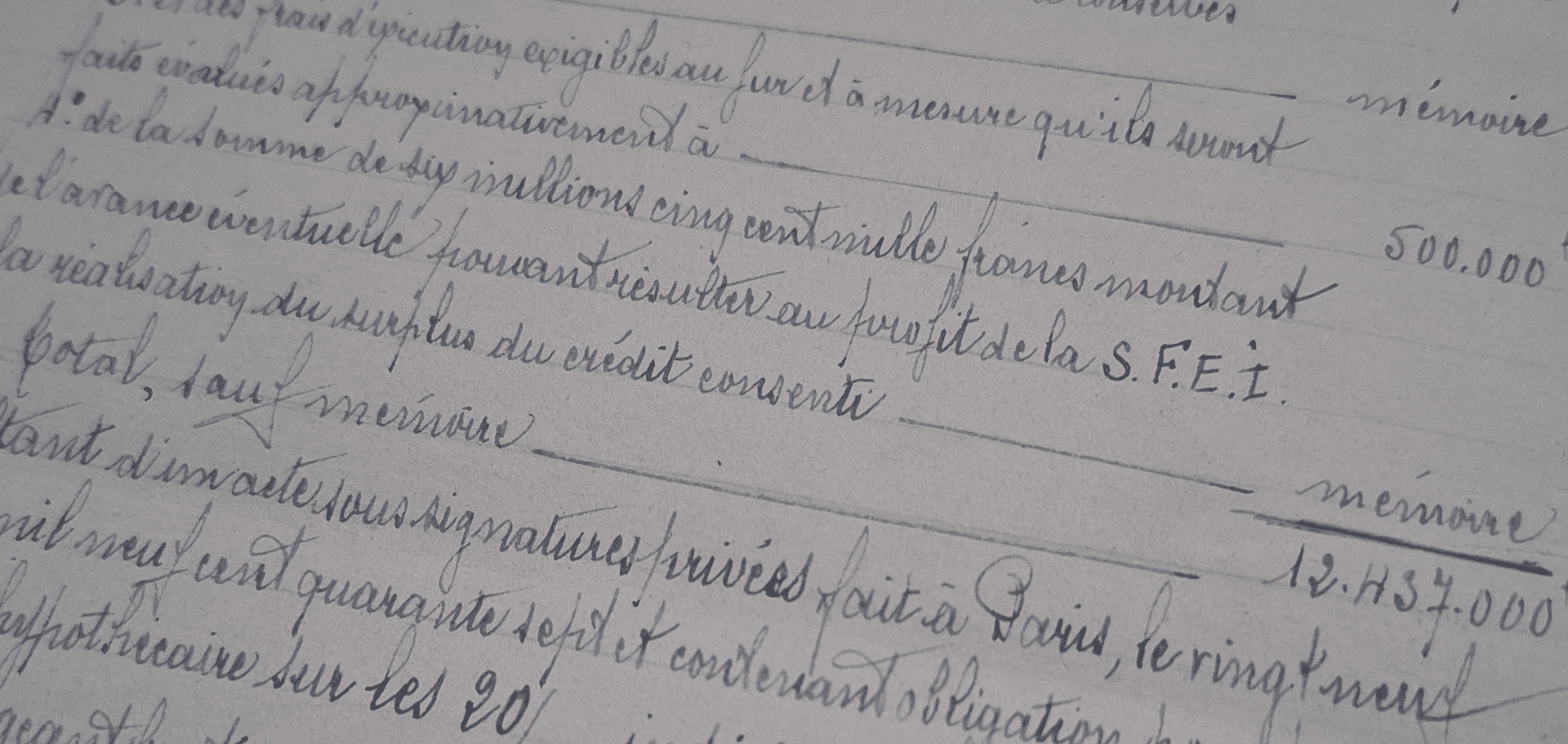
Registered in October 1947 in favour of the Société Financière d’Exploitations Industrielles (S.F.E.I.), based at 61 boulevard Haussmann in Paris, this mortgage secures a principal loan of 11,937,000 francs (€1.819.783,91), more than three times the combined total of the previous three. Add interest, costs, and a potential additional advance of 6,500,000 francs (€990.918,61) , and the total secured exposure reaches approximately 12,437,000 francs (€1.896.008,42), at an interest rate of 10%, maturing in December 1948.
That is a significant debt. And it rests on a steam trawler.
Was the Dragon Bleu’s Financial Position Unusual?
In short: not entirely, but it was certainly on the heavy side.
Post-war France was in the middle of an enormous reconstruction effort. The fishing industry, like many sectors, had been disrupted by the war, and vessel owners were borrowing heavily to refit, re-equip, and get back to work. Multiple mortgages on a single vessel were not uncommon, the maritime mortgage register existed precisely because this kind of layered borrowing was a known feature of the industry.
What stands out here is the sheer scale of the fourth mortgage relative to the vessel and its owners. The S.F.E.I. loan of nearly 12 million francs, secured against a share in a fishing trawler, with a one-year maturity and a 10% interest rate, has the flavour of either a significant business expansion or a financial rescue, possibly both.
The involvement of S.F.E.I. – a financial exploitation company based on the boulevard Haussmann, the heartland of Parisian finance – rather than a specialist maritime lender, is also noteworthy. This was not the kind of institution that typically financed fishing boats. Something larger may have been going on: a fleet purchase, a refitting project, or perhaps simply the reality that by late 1947, the specialist maritime lenders had already extended as much credit as they were willing to.
Then and Now: How Maritime Mortgages Have Changed
The contrast between this 1947 document and a modern maritime mortgage extract could hardly be more stark.
Today, if you want to check the mortgage status of a French-registered vessel, you can access the information through the French customs portal (Douane.gouv.fr) online, often within minutes. The data is digitised, searchable, and standardised across all French ports. A certified extract can be issued electronically.
In 1947, none of that existed. The register was physical, the search was manual, and the certified extract was handwritten by a customs official who had to locate the correct volumes, trace every inscription by hand, and produce a clean copy, all before signing off with the authority of the French state.
The legal framework, however, is surprisingly similar. Maritime mortgages in France are still governed by the principle that a vessel is a moveable asset capable of being charged as security, that inscriptions must be formally registered to be enforceable against third parties, and that a certified state of inscriptions provides a reliable snapshot of a vessel’s encumbrances at a given point in time. The Dragon Bleu’s 1947 document would not look conceptually alien to a modern maritime lawyer, just rather more elegantly written.
What Became of the Dragon Bleu?
The document does not tell us. It ends on 17 November 1947, with four mortgages in force and a major debt due to mature in December 1948. Whether Robain and Classe managed to repay S.F.E.I. on time, whether the vessel was eventually sold or seized, or whether the Dragon Bleu continued to fish the Atlantic for years to come, all of that lies beyond the four pages of this extract.
A Small Piece of Maritime History
What this document offers, beyond its legal and financial content, is a glimpse of how maritime commerce actually worked in the years immediately after the Second World War. It is a reminder that the sea has always been a place where fortunes are borrowed as well as made, and that behind every vessel’s name in a register, there are people taking risks, making deals, and hoping the fishing holds.
The Dragon Bleu may have been a modest steam trawler. But in November 1947, she was carrying a considerable financial weight, all of it carefully recorded in blue ink by a diligent customs clerk in Bordeaux.