A deep dive into a rare 19th-century flag chart
Some weeks ago, I purchased a 19th-century lithograph through an auction house. As a specialist in vessel registration and a lover of maritime history, I simply could not resist.
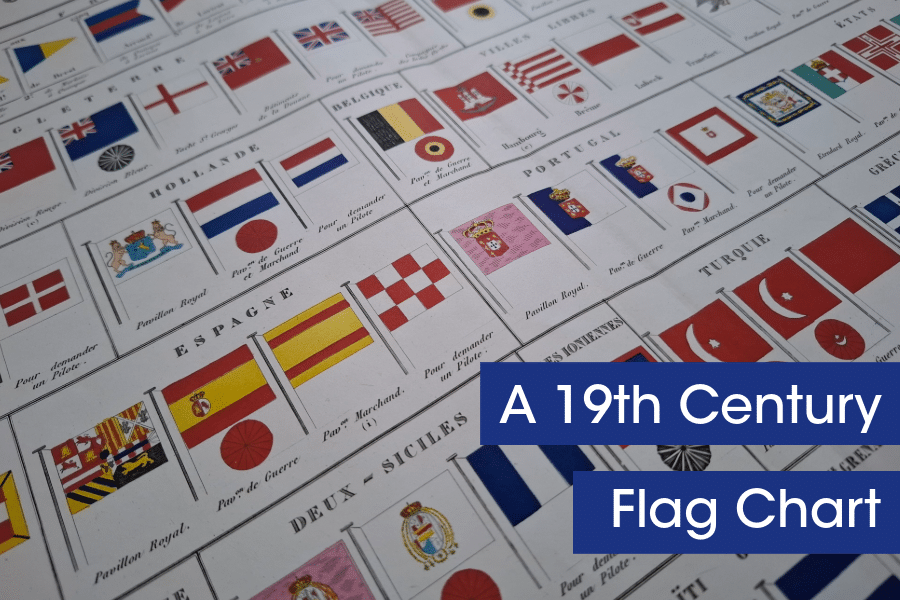
The item in question is a magnificent chart titled Pavillons et cocardes des principales puissances du globe (Flags and cockades of the principal powers of the globe). My version was published by Eugene Andriveau-Goujon in 1863 and originally appeared in the Atlas classique et universel de géographie ancienne et moderne.
At first glance, it is just a beautiful array of coloured flags. However, when you look closer, it tells a fascinating story of geopolitics, naval power, and national identity. It tickled my curiosity immediately. Why, for instance, did the Kingdom of Hanover fly a Red Ensign that looks almost identical to the British one? What do the strange circular symbols represent?
In this post, we are going to explore this print in detail. We will unwrap the history behind the atlas, analyse the specific flags that define the era, and decode the mysterious symbols of the German and Italian states. Whether you are a yacht owner with a passion for history or simply someone who is interested historical flags, I hope you enjoy the read.
The Atlas Classique et Universel
To understand the chart, we must first understand where it came from. The Atlas classique et universel de géographie ancienne et moderne was a comprehensive geographical reference work. Published in Paris, the edition associated with this specific chart dates to roughly 1863, though the plate itself is dated 1860.
Eugene Andriveau-Goujon was a prominent French publisher and geographer. His work was renowned for its precision and quality. This was not merely a book for educational purposes; it was a serious reference tool. In fact, the atlas was officially adopted by the French Minister of War for use in “bibliothèques régimentaires” (regimental libraries).
This military endorsement is significant. It tells us that the information contained within was considered accurate and vital enough for the armed forces. In an era before digital communication, having an accurate visual reference of foreign flags was essential for identification at sea and on land. A mistake in identifying a vessel could lead to a diplomatic incident, or worse, an accidental engagement.

A closer look at the flag chart
The chart itself is a hand-coloured lithograph measuring approximately 58 cm in width and 46 cm in height. For those unfamiliar with the technique, lithography involves printing from a flat surface treated so as to repel the ink except where it is required for printing. The “hand-coloured” aspect means that after the black outlines were printed, colourists (often skilled women in workshops) would painstakingly painted every single flag by hand.
The layout and aesthetic
The composition is meticulously organised. It features a grid displaying a variety of flags and insignias, each clearly labelled with the corresponding country or entity. It is a snapshot of the world order in the mid-19th century.
The work is divided into sections representing different nations or regions. Reading from top left to bottom right, we see the major powers of the day: France, Sweden and Norway (then united), the United Kingdom, Russia, and Prussia. But we also see states that no longer exist as independent entities, such as Hanover, Mecklenburg-Schwerin and Tuscany.
The visual style is highly detailed. The engraver, Chardon, managed to capture the intricate heraldic symbols and crests with remarkable clarity. The colours, despite their age, remain vibrant, a testament to the quality of the pigments used at the time and minimal UV light exposure.
Analysing the flags: A window into 1860
As a vessel registration specialist, it is the flags themselves that draw my eye. They reveal the colonial dynamics, the monarchies, and the naval traditions of the era. Let us look at a few that stand out.

The Hanoverian Red Ensign
One of the first things that caught my attention was the flag of Hanover. It features a red background with the British Union Jack in the top left corner, a design known as the “Red Ensign” or “Red Duster,” which is traditionally the civil ensign of the United Kingdom.
Why would a German state fly a British flag? The answer lies in the “Personal Union.” From 1714 to 1837, the monarchs of the United Kingdom were also the Electors (and later Kings) of Hanover. Although the Personal Union ended in 1837 when Queen Victoria took the British throne (Salic law in Hanover prevented a woman from inheriting the crown), the cultural and naval ties remained strong. The flag depicts a white horse in the centre of the Union Jack, the Saxon Steed, a traditional emblem of the region. It is a wonderful example of how dynastic history is woven into maritime symbols.
The artistic flare of the Chinese flag
Other flags that stand out are those of China. The one on the right, is depicted in a way that it looks remarkably like a work by the surrealist painter Joan Miró. This flag is not a depiction of an official Chinese national flag. Instead, it represents a European fantasy, reflecting the uncertainty Westerners had about Chinese maritime colours before the official adoption of the yellow dragon banner in 1862.
In the mid-19th century, when this chart was created, the Qing Empire did not have a single, standardised national flag in the Western sense. The banners used at sea were typically military or administrative flags tied to regional commands or local authorities. The concept of a single national flag only took hold in China in the 1860s with the introduction of the now-famous yellow dragon flag.
European engravers, often lacking precise information about Asian flags, would frequently fill these knowledge gaps by drawing upon older illustrations that emphasized auspicious symbols like animals, stars, and spirals. This flag is a perfect example of that tradition. The label “Pavillons variables” (variable flags) is a crucial detail; it served as a warning to mariners that Chinese ships flew a diverse array of banners that could not be simplified into the neat, national patterns used by European states. Therefore, this flag tells us more about Western perceptions of China at the time than it does about actual Chinese vexillological practice. It is a fascinating cartographic attempt to visually represent “China” for navigators, bridging the gap between traditional military banners and the formal national flags that would emerge later.
The naval versus merchant distinction
The chart provides a detailed key (labelled a through r) that explains the subtle differences between flags used for different purposes. This is crucial for anyone at sea.
For example, note c describes the flag used by merchant ships. In the British context, this is the Red Ensign without any defacement. However, note b points out the flag for the bowsprit of warship, the Union Jack.
The chart also details the Russian naval distinctions. Note d explains that warships fly a flag with a blue and white cross (the St. Andrew’s Cross), which differs from the merchant flag.
These distinctions were not just administrative; they were functional. A merchant vessel needed to be distinguished from a warship instantly to determine engagement rules or customs requirements.
The shifting map of Europe
The flags of Italy and Germany tell us that this map predates the final unification of these nations. We see separate flags for “Toscana” (Tuscany), “Sicile” (Kingdom of the Two Sicilies), and “Villes Libres” (Free Cities of Germany like Hamburg and Bremen).
The Italian flag shown (note k) is red with a white and red cross, serving as a distinction for the Admiral-in-Chief. This reflects the complex patchwork of duchies and kingdoms that made up the Italian peninsula before the Risorgimento was complete.
Deciphering the circular signs
Between the two text inserts at the bottom of the chart, there are 15 circular signs. They are labelled with names like Brunswick, Nassau, Hesse-Cassel, Bade (Baden), Wurtemberg, and Bavière (Bavaria).
At first, one might assume these are city flags or perhaps shields. However, they are actually stylised depictions of cockades or the badges of orders of chivalry.
What is a cockade?
In the 18th and 19th centuries, European states did not always have a single fixed “national flag” in the way we think of them today. Instead, states had official colours. These colours were displayed on military uniforms, often as a rosette of ribbon worn on a hat, known as a cockade.
These circular diagrams on the chart represent those official state colours, arranged concentrically. They were the “ID cards” of the battlefield and the parade ground.
Decoding the colours
If you look closely at the circle labelled “Bavière,” you will see the colours white and blue. These are the traditional colours of the House of Wittelsbach and are still the colours of the modern state of Bavaria (think of the BMW logo or the Oktoberfest flag).
Similarly, “Saxe” (Saxony) shows green and white, while “Wurtemberg” displays black and red. These circles served as a quick visual key for diplomats and officers. If you saw a soldier with a red and yellow cockade, you could identify him as serving the Grand Duchy of Baden.
It is interesting to see how Andriveau-Goujon included these land-based military symbols alongside the naval ensigns. It reinforces the idea that this atlas was intended for comprehensive military education, adopted by the Minister of War to ensure officers were well-versed in all forms of foreign identification.
The significance and utility of the chart
Why does a chart like this matter today? Aside from its aesthetic beauty, it serves as a powerful historical document.
Culturally, the chart captures a moment of transition. The presence of flags from the Ottoman Empire (“Turquie”) alongside the emerging nations of South America (Venezuela, Ecuador, Buenos Aires) highlights the colonial and post-colonial dynamics of the mid-19th century.
It reminds us that the borders and symbols we take for granted today were once fluid. The “Buenos Aires” flag, for instance, represents a period of civil war in Argentina where the province of Buenos Aires seceded from the Confederation. Seeing it captured here in lithograph form brings that turbulent history to life.
Conclusion
Owning a piece of maritime history like the Pavillons et cocardes chart is always nice, to say the least. It is not just about the paper and the ink; it is about the stories they hold.
From the Personal Union of Hanover and Britain to the hand-painted dragons of the Qing Dynasty, this chart offers us a glimpse into the minds of 19th-century sailors and soldiers. It shows us how they viewed the world, a world of distinct “powers,” represented by colourful ensigns and cockades.
For yacht owners and maritime enthusiasts, documents like these are a reminder of the rich heritage that underpins our time on the water. The next time you hoist your courtesy flag while entering a foreign port, take a moment to think about the centuries of tradition behind that simple act.