Global Flag State Ranking 2026: Who Is Up, Who Is Down
Choosing a flag for your yacht is a bit like choosing a country to call home. Some flags open doors, smooth out inspections and give you peace of mind wherever you drop anchor. Others come with a bit more baggage. That is exactly why the Global Flag State Ranking matters, and why the 2026 edition is worth a proper look.
This year’s ranking covers 148 flag States, six more than last time. The scores are built on figures running from 2012 all the way to 2025, so the picture you get is a genuine trend rather than a one-off snapshot. We will walk you through the headline movers, take a close look at the European field (including the curious case of San Marino), and see what the Dutch shipowners have to say about their own flag. No jargon, we promise…..or at least, none we do not explain along the way.
How the ranking actually works
Before we dive into the numbers, here is a quick tip on reading them. The Global Flag State Ranking is not based on one person’s opinion. It pulls together five independent, publicly available sources and blends them into a single score.
Two of those sources measure hard performance: the Paris MoU and the Tokyo MoU. These are port state control regimes – think of them as roadside inspections, but for ships – carried out in European and Asia-Pacific waters. A third brings in the view from the other side of the Atlantic: the US Coast Guard’s Qualship 21 programme, which admits only flags with a consistently clean inspection record in American ports. A fourth strand looks at the paperwork foundation beneath a register: which international conventions a flag has signed up to and actually enforces. And finally, Transparency International’s Corruption Perceptions Index is added, not to judge any administration directly, but because the wider governance environment tends to rub off on how a register is run.
Two things are worth keeping in mind when you compare this year’s table with last year’s.
First, both MoU regimes work on a three-year rolling window. A flag can shift several places from one year to the next without anything really changing at the register itself. It simply means older inspection results have dropped out and newer ones have rolled in.
Second – and this matters more – a position is only as reliable as the data behind it. Not every flag appears in every source. A register that is inspected rarely, or that falls below the Paris MoU’s threshold of 30 inspections, leaves a gap, and a gap can move a flag in either direction for reasons that have nothing to do with its quality. Ukraine is this year’s clearest case: it appears to climb 33 places, but only because it dropped off the Paris MoU list entirely. The reverse happens too. San Marino falls 24 places not because the register got worse, but because it appeared on the Paris MoU list for the first time.
The practical rule, then: the more sources cover a flag, the more confidence its position deserves. Where a movement is driven by data coverage rather than performance, we say so.
The scores are then sorted into three colour bands – green, yellow and red – which echo the familiar white, grey and black lists of the Paris MoU. Read them as helpful indicators, not final verdicts.
The top of the table stays calm
The good news for anyone flying a well-regarded flag: the summit barely moved.
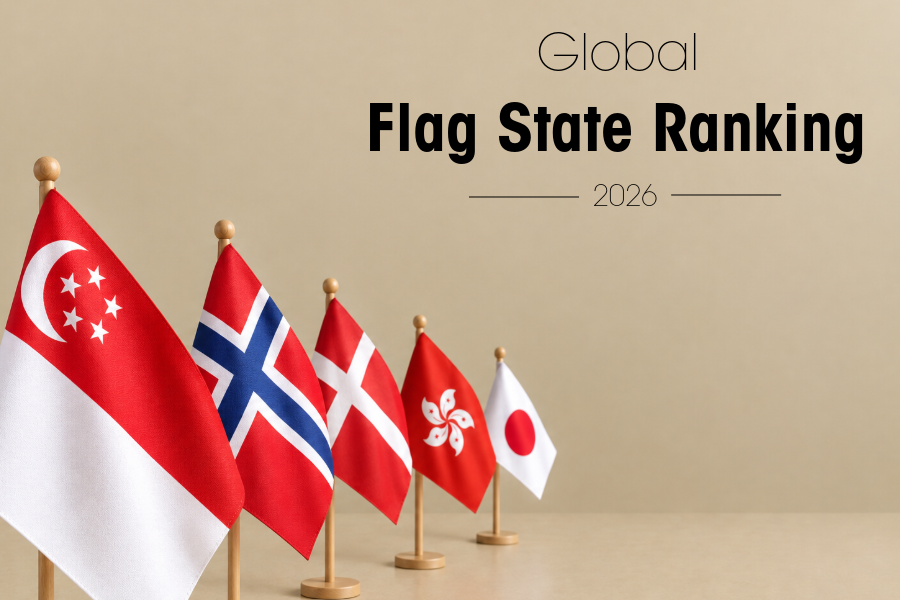
Singapore holds firm at number one. Norway and Denmark simply swapped second and third, while Hong Kong and Japan stayed exactly where they were. Rounding out the top ten are France, the Cayman Islands, Germany, the Bahamas and Luxembourg. Solid, dependable, and reassuringly stable.
Beneath that serene surface, though, there was plenty of movement, and most of it came down to those rolling MoU windows updating from 2022–2024 to 2023–2025.
The biggest genuine risers
Some flags earned their climb the honest way, judged on exactly the same measures in both years.
- Saudi Arabia made the most eye-catching leap among established registers, rising from 27th to 20th and crossing into the green band. It jumped from the Paris MoU Grey List to the White List, a real vote of confidence.
- Panama made the same Grey-to-White move, climbing from 81st to 73rd and shifting from red to yellow.
- Sweden rose eight places to 14th, largely by claiming second spot on the Paris MoU White List (up from twelfth).
- The Isle of Man improved nine places to 12th, and Bermuda gained seven, both on the back of stronger Paris MoU standings.
A word of caution here. A few flags appear to have soared, but the climb is more mechanical than meaningful. Ukraine, for instance, leapt 33 places – yet the main reason is that it fell off the Paris MoU list entirely (it no longer meets the 30-inspection threshold), taking its worst score with it.
The biggest genuine fallers
Not every flag had a good year.
- Pakistan suffered the single largest true fall, dropping 35 places from 52nd to 87th after its Tokyo MoU position collapsed. That was enough to tip it from yellow into red.
- Turkey fell 18 places to 49th – the most consequential slip for many European and Middle-Eastern operators – as it slid from the White list into the Grey list on the Tokyo MoU list.
- Egypt dropped 25 places into red after moving from the Paris MoU White List to the Grey List.
Two green-band casualties are worth singling out, because they matter to a lot of yacht owners. Italy fell nine places to 26th and out of green, and Cyprus fell thirteen places to 33rd, also losing its green status. Both slipped on the Tokyo MoU side of the ledger.
Six new names on the list
Six flag States appear for the very first time, and all six enter in the red band. They are Malawi, Mali, Aruba, Angola, Benin and Mozambique. Each arrived via the Tokyo MoU, which recorded inspections of their tonnage in the Asia-Pacific region for the first time.
The standout newcomer – and perhaps the most intriguing – is Malawi. A landlocked country with no coastline to speak of, it enters the list at 79th place. Malawi is no stranger to controversy in maritime circles: Lloyd’s List has previously uncovered a large-scale fraudulent ship registration network operating under its flag, in which vessels were issued with bogus Malawian documents without the knowledge of the country’s own authorities. That the registry continues to attract tonnage inspected under the Tokyo MoU is, to put it mildly, worth a raised eyebrow or two. Mali, also landlocked, makes its debut at 99th. Neither appearance is conclusive evidence of wrongdoing in itself, but both registries are ones to watch with a degree of healthy scepticism.
| Rank | Country |
|---|---|
| 1 | Singapore |
| 2 | Norway |
| 3 | Denmark |
| 4 | Hong Kong |
| 5 | Japan |
| 6 | France |
| 7 | Cayman Islands |
| 8 | Germany |
| 9 | Bahamas |
| 10 | Luxembourg |
| 11 | Malta |
| 12 | Isle of Man |
| 13 | Portugal |
| 14 | Sweden |
| 15 | Marshall Islands |
| 16 | China |
| 17 | Greece |
| 18 | Bermuda |
| 19 | Spain |
| 20 | Saudi Arabia |
| 21 | Finland |
| 22 | Netherlands |
| 23 | South Korea |
| 24 | Ireland |
| 25 | United Kingdom |
| 26 | Italy |
| 27 | Belgium |
| 28 | Liberia |
| 29 | Malaysia |
| 30 | United States of America |
| 31 | New Zealand |
| 32 | Canada |
| 33 | Cyprus |
| 34 | Gibraltar |
| 35 | Poland |
| 36 | Chile |
| 37 | United Arab Emirates |
| 38 | Taiwan |
| 39 | Faroe Islands |
| 40 | Philippines |
| 41 | Estonia |
| 42 | Curaçao |
| 43 | Barbados |
| 44 | Kuwait |
| 45 | Thailand |
| 46 | Croatia |
| 47 | Jamaica |
| 48 | Switzerland |
| 49 | Turkey |
| 50 | Latvia |
| 51 | Ukraine |
| 52 | Argentina |
| 53 | Israel |
| 54 | Qatar |
| 55 | Lithuania |
| 56 | Bahrain |
| 57 | Indonesia |
| 58 | Iceland |
| 59 | India |
| 60 | Bulgaria |
| 61 | Antigua and Barbuda |
| 62 | Seychelles |
| 63 | Oman |
| 64 | Australia |
| 65 | Saint Vincent and the Grenadines |
| 66 | Kiribati |
| 67 | Brazil |
| 68 | Libya |
| 69 | Ethiopia |
| 70 | Tuvalu |
| 71 | Russia |
| 72 | South Africa |
| 73 | Panama |
| 74 | Morocco |
| 75 | Jordan |
| 76 | Falkland Islands |
| 77 | Mauritius |
| 78 | Vietnam |
| 79 | Malawi |
| 80 | Georgia |
| 81 | Algeria |
| 82 | Dominica |
| 83 | Tonga |
| 84 | Sri Lanka |
| 85 | Romania |
| 86 | Brunei |
| 87 | Pakistan |
| 88 | Nigeria |
| 89 | Ghana |
| 90 | Myanmar |
| 91 | Mexico |
| 92 | Gabon |
| 93 | Kenya |
| 94 | Bangladesh |
| 95 | Guinea-Bissau |
| 96 | Tunisia |
| 97 | Cuba |
| 98 | Egypt |
| 99 | Mali |
| 100 | Montenegro |
| 101 | Trinidad & Tobago |
| 102 | Micronesia |
| 103 | Vanuatu |
| 104 | Sierra Leone |
| 105 | North Korea |
| 106 | San Marino |
| 107 | Colombia |
| 108 | Albania |
| 109 | Equatorial Guinea |
| 110 | Iran |
| 111 | Jersey |
| 112 | Cook Islands |
| 113 | Côte d’Ivoire |
| 114 | Bolivia |
| 115 | Uruguay |
| 116 | Lebanon |
| 117 | Niue |
| 118 | Fiji |
| 119 | São Tomé and Príncipe |
| 120 | Moldova |
| 121 | Mongolia |
| 122 | Cambodia |
| 123 | Belize |
| 124 | Palau |
| 125 | Honduras |
| 126 | Togo |
| 127 | Saint Kitts and Nevis |
| 128 | Venezuela |
| 129 | Maldives |
| 130 | Papua New Guinea |
| 131 | Aruba |
| 132 | Peru |
| 133 | Tanzania |
| 134 | Syria |
| 135 | Angola |
| 136 | Ecuador |
| 137 | Benin |
| 138 | Comoros |
| 139 | Djibouti |
| 140 | Mozambique |
| 141 | Eswatini |
| 142 | Guyana |
| 143 | Nauru |
| 144 | Gambia |
| 145 | DR Congo |
| 146 | Guinea |
| 147 | Sint Maarten |
| 148 | Cameroon |
A closer look at Europe
Thirty-eight European flag States and territories feature in the 2026 ranking. Of those, fifteen sit in green, sixteen in yellow and seven in red.
Norway leads the European field at 2nd globally, just ahead of Denmark at 3rd, the only change at the top being that the pair swapped places. Among EU members, the strongest performers are Denmark, France, Germany, Luxembourg and Malta, all comfortably inside the global top eleven.
At the other end, the weakest EU register by some margin is Romania at 85th, sitting in red. The five lowest-ranked European flags overall are Moldova (120th), Jersey (111th), Albania (108th), San Marino (106th) and Montenegro (100th).
The three largest European movements tell three different stories: Ukraine (+33, coverage-driven), Montenegro (+27, a genuine Tokyo MoU improvement) and Turkey (−18, a genuine Tokyo MoU decline).
The curious case of San Marino
Here is a puzzle worth pausing on. San Marino fell 24 places, from 82nd to 106th. At first glance, that looks like a disaster. It is not.
The story is almost the opposite of a decline. San Marino first appeared in the ranking in 2023, scored on its Tokyo MoU position alone, a flattering 36th, cushioned by a heavy coverage penalty for having only one measure. In 2025 something new happened: San Marino appeared on the Paris MoU list for the first time, entering directly onto the Grey List at 46th of 69.
So why the drop? Because acquiring that second measure gave a fuller, and frankly less flattering, picture. The register has not deteriorated by 26 places at all. It has simply become visible on a second regime, and what became visible was a Grey listing. Sometimes a lower number on the table reflects more honesty in the data, not worse performance on the water.
What the Dutch shipowners make of it
The Dutch flag sits at 22nd globally in the 2026 ranking, holding steady in the green band, though it slipped four places from 18th. According to the Koninklijke Vereniging van Nederlandse Reders (the Royal Association of Dutch Shipowners, or KVNR), the Netherlands landed 9th on the Paris MoU White List.
The KVNR notes that the Dutch flag remains firmly on the White List – the top tier – which is what really counts for shipowners. The dip in position was not caused by Dutch ships performing worse. Rather, the Netherlands was nudged down the White List by strong showings from the likes of the Cayman Islands, Sweden and Japan. Its actual inspection record held up perfectly well.
It is a neat illustration of a wider truth in these rankings: your neighbours’ performance can move your position just as much as your own. A White List place is a White List place, and that is the number Dutch owners are rightly proud of.
What this means for you
So where does all of this leave you and your vessel?
If you fly one of the top-tier flags – Singapore, Norway, Denmark, France, the Netherlands and so on – you can breathe easy. Green is green, and these registers continue to deliver smooth inspections and a solid reputation that makes life easier in every port of call, whether you are dropping anchor in a sun-drenched marina or running a tight operational schedule off the coast of Singapore.
If your flag slipped this year, take a breath before drawing conclusions. As we have seen, a good chunk of the movement comes down to rolling data windows and coverage quirks rather than any genuine decline in performance. Cyprus and Italy dropping out of green, or San Marino’s puzzling tumble, are cases in point.
And if you are weighing up a change of flag – whether you are a recreational owner looking for ease and prestige, or a professional operator for whom compliance and port state efficiency are bottom-line concerns – the ranking is a genuinely useful starting point. But it is only a starting point. The right flag depends on where you operate, how you use your vessel, and what matters most to your specific situation.
Frequently asked questions
What is a flag State, in plain English?
A flag State is simply the country your yacht is registered with. Its flag tells the world which nation’s laws and safety rules your vessel follows. It affects everything from inspections to paperwork to how you are treated in foreign ports.
Why did some flags move so much without anything changing?
Because the Paris MoU and Tokyo MoU work on three-year rolling windows. Each year, older inspection results drop off and newer ones roll in. A flag can rise or fall several places purely from this shuffle, without its real performance changing at all.
Is a lower ranking always bad news?
Not necessarily. San Marino is the perfect example, it fell 24 places simply because it became visible on a second inspection regime, giving a fuller picture. Always look at why a flag moved before drawing conclusions.
Which flags are the safest bet?
The green-band flags sitting at the top of the table – Singapore, Norway, Denmark, France and the Netherlands among them – offer the most reassuring combination of strong inspection records and solid governance. Whether you are a recreational sailor looking for peace of mind, a charter operator who cannot afford port state headaches, or a professional running working vessels across international waters, these flags tend to hold up well under scrutiny. That said, the flag that suits you best will depend on your specific situation, where you sail, how you operate, and what regulatory environment you are working within.
Overline
If you are looking for a comprehensive overview of flag state rankings, you might find our Flag State Ranking page, a very handy resource.
From 2012 to 2025, it presents all rankings neatly laid out as a table or an interactive map.
This makes it easy to compare data across years, spot trends, and identify which flag states consistently perform well in terms of compliance, safety, and quality standards.