Flags Under Which the Dark Fleet Sails
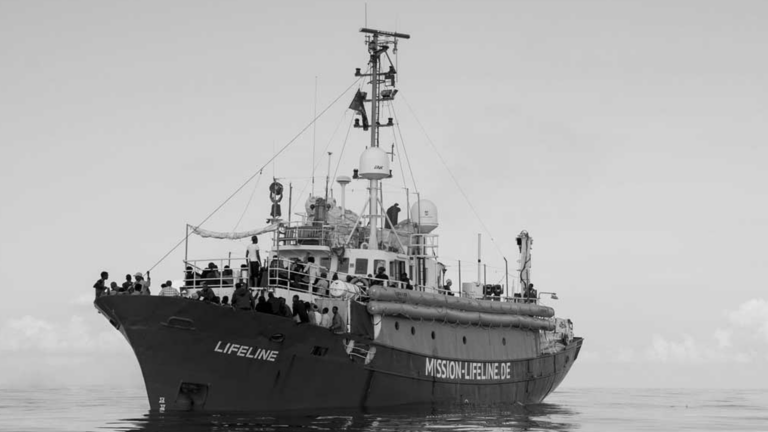
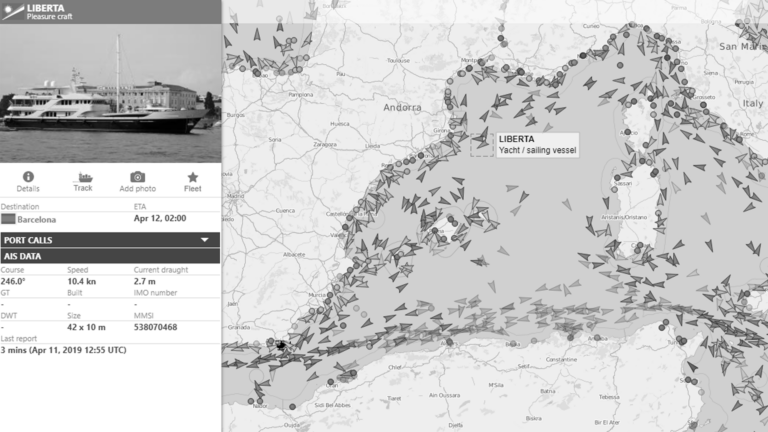
The shadow or dark fleet are vessels that employ shady practices to evade detection and tracking, often to smuggle sanctioned crude oil. Amongst these practices is switching off their transponders, otherwise known as “going dark,” which is where the dark fleet got its name.
In this article, we examine the flags under which dark fleets operate, focusing on vessels subject to international or unilateral economic sanctions.
Drawing from an analysis of 1261 vessels, this research outlines key patterns in flag registration across sanctioned fleets from Russia, Iran, North Korea, and other countries. It also highlights how certain flag states, particularly flags of convenience, accommodate these vessels.
Introduction to the Dark Fleet
The dark fleet uses concealing tactics to smuggle illicit goods, mainly crude oil, from sanctioned countries. Other illicit cargo, like chemicals, coal, and weapons, are also transported, but on a smaller scale. Most dark fleet vessels are either anonymously owned or feature a complex corporate ownership structure that makes tracing their ownership sometimes challenging.
Prior to the Ukraine-Russia war, the dark fleet predominantly focused on shipping Iranian and Venezuelan oil. However, since price caps and sanctions were put into place against Russia in 1Q23, the dark fleet’s size and activities have increased to accommodate smuggling sanctioned Russian crude oil.
Besides the tactic of turning off their tracking transponders, these dark or shadow fleet vessels often operate out of sight of authorities to avoid detection. For example, in international waters beyond the jurisdiction of coastal states, where discreet ship-to-ship transfers can take place undetected.
Very often, such vessels are of age and do not meet international safety requirements in regard to shipping, environmental, and safety regulations, as agreed upon in different international maritime treaties, such as the IMO Conventions (SOLAS, MARPOL, and STCW). Whitelisted flag states, which generally operate under these treaties, therefore, do not accommodate such vessels.
Research Methodology
Over 1260 dark fleet vessels were identified on a number of international sanctions lists, as issued by the USA, UK, and EU. No discrimination was made with regard to the type of sanction. The list, therefore, includes sanctions against Russia, Iran, North Korea, China, Venezuela, Cuba, and various other territories.
Vessels were only identified individually by their IMO number and not their name. The latter can be changed fairly simply and is another tactic dark fleet vessels often employ to make tracing their movements harder. Furthermore, the specific sanction and the dark fleet vessel’s flag, as identified on the sanction list, were recorded.
At random, a small selection of these vessels was checked in the IMO database, which uncovered that it was common practice for dark fleet vessels to change their flag state after being sanctioned. In some cases, the new flag was not known, or the vessel sailed under a flag illegally.
Illegally, in the sense that the vessel was no longer registered in that particular ship’s register but still remained sailing under that state’s flag. A practice that can result in severe repercussions like vessel detainment, blacklisting, fines, and lawsuits. Well, unless the flag belonged to a country that’s already sanctioned or one less likely to enforce regulations.
The Russian Shadow Fleet
Nearly 300 sanctioned Russian vessels were analysed. The majority of the vessels were crude oil tankers, used for the obvious purpose of smuggling sanctioned Russian oil. In some cases, not just to move the illicit oil, but to circumnavigate price caps to get a higher return on the oil.
Of all the sanction lists analysed for this article, including those of Venezuela, North Korea, and other prominent countries, the Russian sanction list was the only one that also had superyachts on it, if fewer than a handful.
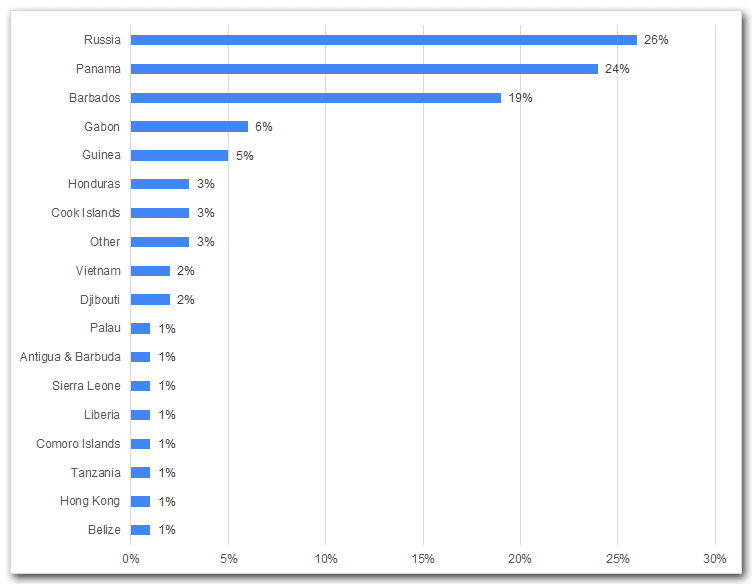 Russia’s dark fleet mainly sails under its own country flag, but also other territories like Panama, Barbados, and Gabon.
Top 10 Russian Shadow Fleet Flags
- Russia
- Panama
- Barbados
- Gabon
- Guinea
- Honduras
- Cook Islands
- Vietnam
- Djibouti
- Palau
The flag states categorised under “Other” are the Cameroon, Cayman Islands, Eswatini, Gambia, Malaysia, Marshall Islands, San Marino and Sao Tome and Principe. The number of vessels registered under each of these flag states was just one vessels per state.
The Sanctioned Vessels of North Korea
Nearly 65% of all North Korean dark fleet vessels are flagged in North Korea. As opposed to many other countries’ lists of sanctioned vessels, 10% of all North Korean sanctioned vessels are ghost vessels in the sense that it’s not known under which flag they sail. A fraction of the listed vessels under the “Others” category were registered in Barbados, Singapore, Tanzania, and Vietnam.
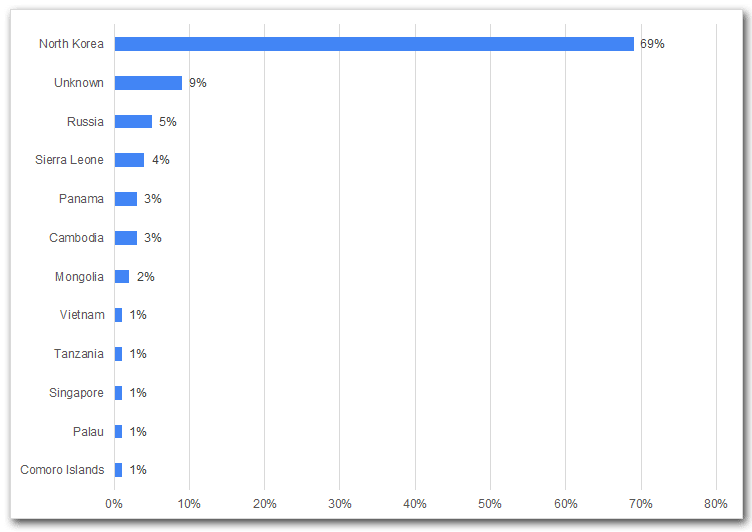 The flags of the “Unknown” ghost vessels cannot be traced, accounting for a considerable 9% of North Korea’s dark fleet.
Top 5 Flags of North Korean Sanctioned Vessels
- North Korea
- Russia
- Sierra Leone
- Panama
- Cambodia
The Dark Fleet of Iran
Just like with North Korea, the majority (66%) of Iran’s vessels sailed under its own flag. Here again, Panama is an important accommodator, accounting for 10% of vessel registrations. Just 7% of the Iranian fleet is flagged under “Other” in countries like Comoro Islands, Djibouti, Eswatini, Guyana, Marshall Islands, Palau and Tuvalu.
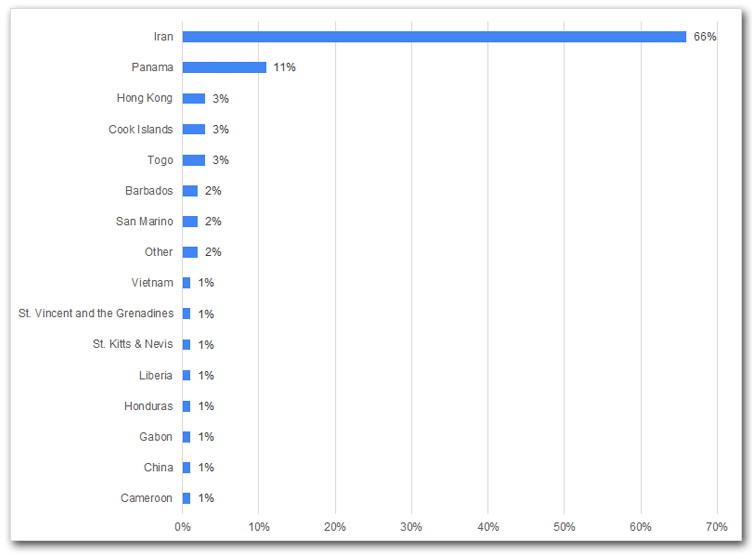 Of all dark fleets, Iran has one of the largest, of which the majority is registered under their own flag.
Top 10 Flags of Iranian Sanctioned Vessels
- Iran
- Panama
- Hong Kong
- Cook Islands
- Togo
- Barbados
- San Marino
- Vietnam
- Vincent and the Grenadines
- Kitts and Nevis
Taiwan’s Sanctioned Vessel List
Taiwan has also recently created a vessel sanction list as part of an effort to crack down on dangerous ships sailing in Taiwan’s waters. Due to the rising tensions with China, an explosion in shadow fleet vessel numbers, and increased undersea cable sabotage, Taiwan feels it’s a necessary step.
China claims Taiwan is part of its territory, but Taiwan upholds its independence. So, the effort also aims to deter and capture any Chinese vessels operating covertly as military. However, this new list mainly features Chinese-owned vessels registered under flags of convenience in Cameroon, Tanzania, Mongolia, Togo, and Sierra Leone, which appear most likely to allow fraudulent ship registrations.
These vessels were not included in this analyses, as we did not have access to the data.
The Flags Most Commonly Used by Sanctioned Vessels
Generally, sanctioned vessels are registered under their own country’s flag (national fleet). However, these vessels can also be flagged under a foreign nation’s flag, if it’s willing.
The foreign flag state that accommodates the most international sanctioned vessels is Panama. Roughly one-third of all sanctioned vessels were registered in Panama.
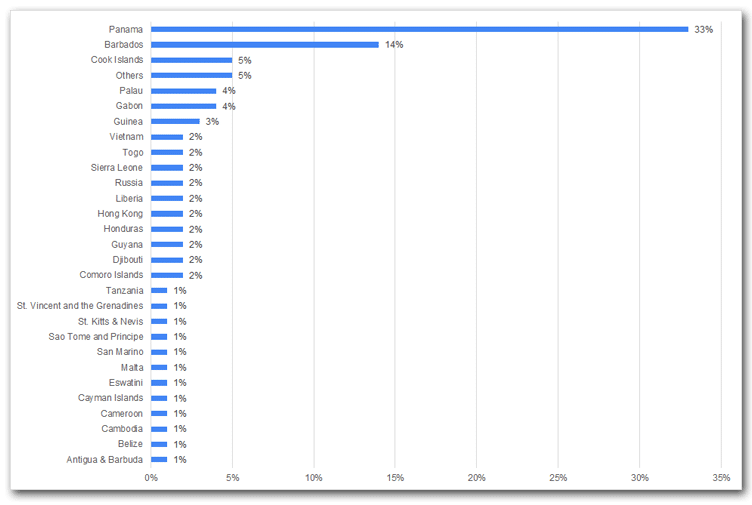 A combination of corruption and convenience makes Panama the pre-eminent choice for sanctioned vessels.
The flag states categorised under “Other” are the British Virgin Islands, Cuba, Gambia, Kiribati, Malaysia, Marshall Islands, Mongolia, Samoa, Singapore, Sint Maarten, Turkey and Tuval.
Truly remarkable is that both Liberia and the Marshal Islands hardly play a role, despite Liberia being the world’s largest ship register in terms of capacity and the Marshal Islands being the third largest. Liberia leads with 408 million deadweight tons (dwt), followed by Panama with 380 million dwt, and the Marshall Islands with 309 million dwt.
Could that possibly be because both ship’s registers are administrated by an American entity, owned and operated by Americans? It’s not very likely because there are other smaller ship registers that are also owned and operated out of the USA.
It’s not uncommon that flag states, and specifically flags of convenience, subcontract the administration and operations of their ship registries to privately owned foreign companies. Additionally, national registers subcontract the management to another flag state. Guinea’s registry, for example, is managed by a commercial entity in Greece.
Flags of Convenience and Their Part In Aiding Dark Fleets
Flags of convenience, also known as open flags, are flag states that accept vessels regardless of the nationality of the owner. These flag states very often offer advantages to attract ship owners, such as lower operating costs, tax benefits, and flexible rules with regard to periodical inspections.
Some flags of convenience, but most definitely not all, are also lenient on matters like labour standards onboard and both personal and environmental safety. Very often, such flag states have no binding international maritime agreements in place, which is an attractive proposition for dark fleet operatives.
Of the 1261 dark vessels analysed, 32% are registered under a flag of convenience. If the national fleet (vessels registered under their own country’s national flag) and Russian, Iranian, and Chinese-flagged vessels are excluded, then 96% of the entire shadow fleet sails under a flag of convenience.
The International Transport Workers Federation has categorised the following 43 flag states as flags of convenience:
(As far as we have been able to determine, specified between brackets, if applicable, is the country from which the ship register is actually administrated and operated.)
|
|
A flag state we had to look up on Google Maps was Eswatini. The Kingdom of Eswatini, formally known as Swaziland, is a landlocked flag state in southern Africa whose business model seems to be to accommodate sanctioned vessels that have been rejected by flag states that honour international agreements, laws, and regulations. Estwatini’s ship register was established in 2023, and whether it’s run by the Kingdom or a third party is difficult to establish.
Conclusion: The Challenge of Dark Fleet Regulation
It’s fair to say that there are flag states that have no problem catering to sanctioned vessels and have even made it their primary business. In contrast, there are also those who ban vessels outright the moment they’re placed on a sanction list. It would be interesting to determine which flag states accommodated vessels after they were sanctioned and changed flags.
However, it’s a challenge to regulate and fight against the abuse of international maritime conventions put into place to protect vessels, crew wellbeing, cargo safety, and, last but certainly not least, the marine environment.
As The IMO Final Report of the Study Group on Fraudulent Registration and Fraudulent Registries of Ships concluded, there’s no binding international framework to regulate the process of vessel registration. There’s also a lack of well-developed legal systems, which makes it hard to fight against abuse.
It is ultimately the responsibility of each flag state to regulate its own vessels, which causes issues when the country is sanctioned. In particular, it’s very difficult to uphold international agreements when there are flag states that jump at the opportunity of accommodating shipping companies who are in the trade of sanction evasion.
However, some ways to mitigate dark fleet activity include:
- Holding flag states accountable for lack of regulation of their vessels, including imposing harsher legal and financial penalties.
- Port state authorities could increase their inspections and scrutiny of docking foreign vessels to identify fraudulently registered and dark fleet vessels. Furthermore, offering advanced training of these staff to ensure unscrupulous activity isn’t overlooked.
- Implementing stricter legal and financial penalties for the owners and operators of fraudulently registered ships and dark fleet vessels. Additionally, raising awareness of these penalties in the maritime industry and to the general public.
- Enhancing admin processes and systems with better technologies and data analysis to detect dark fleet and fraudulently registered ships and activities early on.
- Better collaboration among flag state nations to address, implement, and maintain regulations, conventions, treaties, issues, and processes, including sharing information on suspicious activity.
- Independent administration of surveys and inspections by an authorized international body, which could be responsible for drafting further treaties to ensure international conventions are followed by the vessels they inspect.
- Encourage more standardized regulations across various international conventions or treaties.
References:
- EU sanction designated vessels, Danish Maritime Authorities
- Final Report of the Study Group on Fraudulent Registration and Fraudulent Registries of Ships, 2024, IMO
- Office of Foreign Assets Control, USA
- Shifty Shades of Grey, Lloyd’s List Intelligence
- Taiwan blacklists Chinese-owned ‘shadow fleet’ships, 27 Jan. 2025, The Financial Times
- The Good, the Bad and the Ugly: The Flagging Standards of Flag States, 26 Jan. 2024, Lloyd’s List Intelligence
- UK Sanctions List Publication
- UNCTAD Handbook of Statistics 2024, UNCTAD
- War Sanctions, GUR