AIS tracking and yacht owner privacy: notes on “The right to vanish” by Benjamin Maltby
On 6 October 2026, SuperyachtNews published “The right to vanish”, an article by Benjamin Maltby, a lawyer and General Secretary of The Owners Club. In it, he looks at whether yacht owners have a legal right not to be followed online through their AIS signal. This post gives a short summary of his argument and two questions it left me with. To be clear from the start: the legal analysis below is entirely Maltby’s, not ours. We are vessel registration specialists, not data protection lawyers. You can read his full article on SuperyachtNews.
Who wrote “The right to vanish” and where it was published
The article is by Benjamin Maltby and appeared in the Owner section of SuperyachtNews, which is part of The Superyacht Group. Maltby writes as a lawyer, and he works mainly from UK law, such as the UK GDPR and the Data Protection Act 2018. He ends with a clear note that his article is not legal advice. I am repeating that note here, and it applies to this summary as well.
AIS as a safety tool, according to Maltby
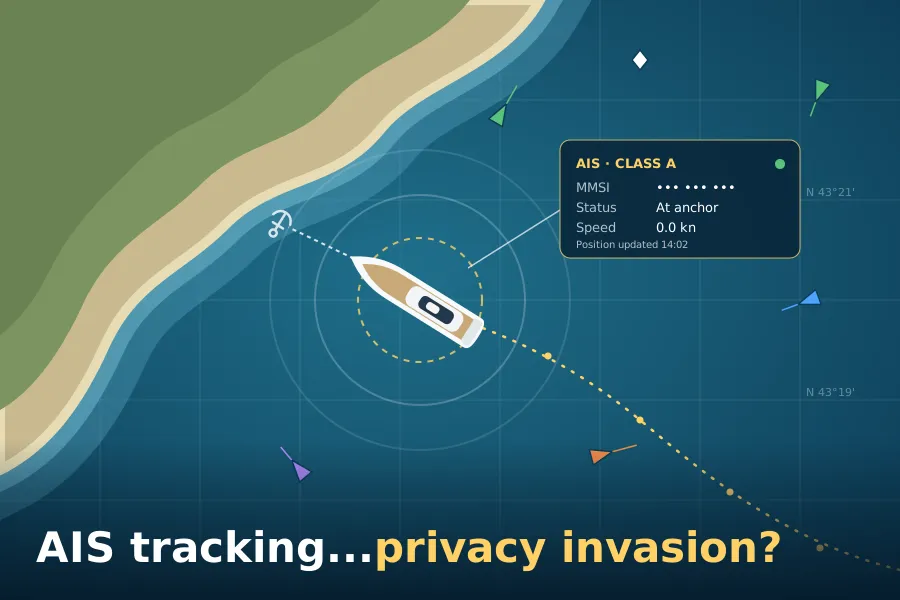
Maltby starts with a fair point: AIS itself is not the problem. He reminds readers that yachts of 300 gross tonnage or more on international voyages must carry Class A AIS equipment under SOLAS Chapter V, Regulation 19. The system sends position and other data by short-range radio to nearby vessels. It adds to the radar picture and helps in search and rescue.
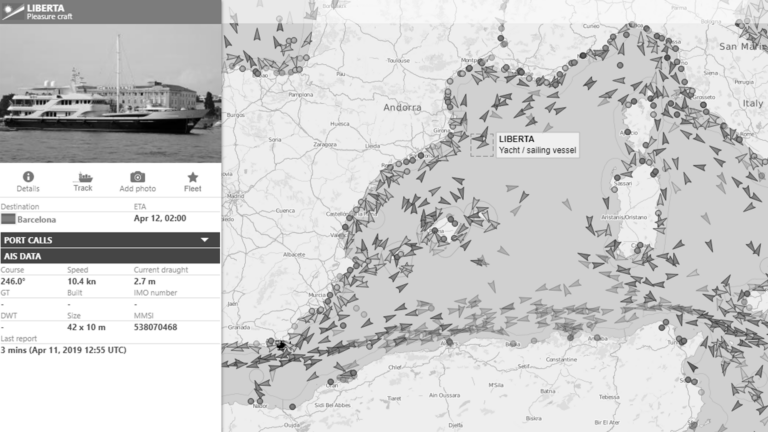
The trouble starts, he argues, when online tracking platforms collect this data, store it, add other information to it and sell it to anyone who is interested. A signal meant for the ships around you then becomes a public record of where you have been. Simply switching AIS off is not an answer, he notes, because that is not lawful and it may also cause problems with your insurance after a collision.
Why Maltby sees AIS data as personal data under GDPR
His central argument is that a yacht is not a cargo ship. It is a private place where owners, families, guests and crew spend their free time. When a vessel is clearly linked to one person, its position also tells you where that person is. In Maltby’s view, AIS data can therefore become personal data, and the GDPR names location data in its definition of personal data.
From there, he goes through the legal grounds a website would need to publish that data. Consent, contract, legal duty and the other grounds do not fit, he says. Only “legitimate interest” is left, and even that ground needs a balancing test in which the yacht owner’s privacy is very important. He also points to the rule that data should only be used for the purpose it was collected for. AIS is broadcast for safety, so publishing it for strangers online is, in his view, a different and incompatible purpose.
Court cases and other legal routes in the article
Maltby also looks beyond the GDPR. He refers to Article 8 of the European Convention on Human Rights, which protects private and family life, and to two judgments of the European Court of Human Rights on GPS tracking (Uzun v Germany and Shimovolos v Russia). He admits openly that those cases were about state surveillance, not yacht tracking websites. He also discusses the UK civil claim for misuse of private information, two well-known cases involving famous people and their children, and a criminal offence in the UK Wireless Telegraphy Act 2006 about intercepting radio signals.
His conclusion fits in one question, which he leaves for the courts: “when does maritime transparency stop being safety, and start becoming surveillance?”
Why I found it an interesting read
I found the article interesting and informative. It takes a system that most of us see only as a safety device and asks what happens to the data once it leaves the yacht. It made me think, and it left me with two questions that I cannot answer myself.
Question 1: what could this mean for AIS data sharing services?
Many websites and apps show ship positions on a map, live and from the past. For a lot of them, AIS data is the core of the business. If Maltby’s line of reasoning were followed by a court, could it affect how these services work, or even their business model? Would they need to treat yachts differently from cargo ships and ferries? I do not know, and I am curious what you think.
Question 2: does the same protection apply to someone who charters a yacht?
Maltby writes about owners, and about people who regularly use a vessel, even crew members. But what about a charter guest? Someone who charters a yacht for two weeks does not own it. Would the position data of that yacht also count as their personal data, and be protected by the same laws? Or is being on board enough, even if the yacht belongs to someone else?