
You are a gatekeeper under AML law. Your due diligence needs to reflect that.
Yacht brokers, maritime lawyers, and vessel registration specialists have legal obligations under national AML/CTF legislation. A passport copy and a Google search do not meet them. The CDD On Demand tool was built specifically for the maritime sector, and through Lorrendraaier, you can activate the Maritime Risk Set and receive a permanent 10% discount on every credit purchase.

The “I did not know” defence is no longer available
Under the EU Anti-Money Laundering Directives, implemented in national law across all 27 EU member states, maritime professionals are classified as obligated entities, or gatekeepers. This means you have specific, enforceable legal obligations at every stage of a client relationship, not just at the point of signature.
The maritime sector is a known vector for high-value money laundering. Vessels are mobile, cross-border assets with complex ownership structures. Authorities know this, and they look at intermediaries first when a vessel later becomes connected to criminal activity, brokers, lawyers, charter companies, shipyards, and registration specialists all fall within scope.
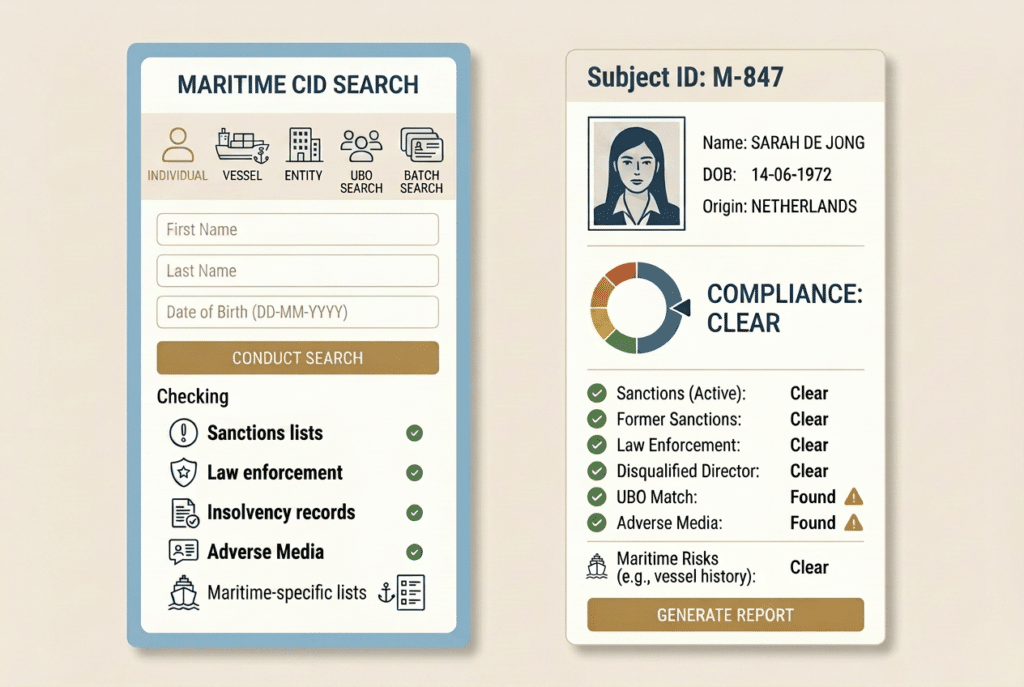
If your due diligence file consists of a passport copy and a printout from a search engine, you are exposed. A structured professional CDD check is not optional for compliance purposes, it is the minimum standard that will withstand regulatory scrutiny. Generic tools do not understand the maritime context. The CDD On Demand platform does.
Your obligations at a glance
- Identify and verify your client’s identity before entering into a business relationship – KYC
- Establish who the Ultimate Beneficial Owner (UBO) is when dealing with a company
- Screen clients against PEP databases, EU/UN/OFAC sanctions lists, and insolvency registers
- Assess the risk level of the transaction against the client’s profile
- Monitor for anomalies during the transaction
- Report to the Financial Intelligence Unit (FIU) where required
- Retain all due diligence records for a minimum of five years in audit-ready form
- Demonstrate how you arrived at the decision to proceed, not just that you did a check
A search engine query produces results for negative media, news articles about past convictions or scandals. It does not check structured sanctions lists, which are updated daily and rarely make headlines. It does not identify Politically Exposed Persons (PEPs) unless they have already featured in the press. It produces false positives for common names and false negatives for clients with no public profile. And it cannot weigh any of these factors against the specifics of the transaction.
Courts and regulators are increasingly explicit about this. Documenting a Google search alongside a passport copy is not a defensible compliance record. It is an indication that you treated due diligence as a formality rather than a genuine risk assessment. The consequence – fines, criminal liability, reputational damage – reflects that distinction.
Your obligations cover three phases, not just the point of sale
AML/CTF compliance is not a one-time check. It applies before, during, and after the transaction. The CDD On Demand tool supports all three.
Pre-transaction – Know Your Customer
Before you sign a contract or accept funds, you must identify and verify your client. This is the KYC phase.
- Identity verification including selfie-based passport check
- PEP status check against structured databases
- Sanctions list screening: EU, UN, OFAC
- UBO investigation for company clients
- Initial risk score: Low, Medium, High, or Unacceptable
During the transaction – monitoring
Due diligence does not end at contract signature. You must monitor the transaction for anomalies.
- Is payment coming from a third party unrelated to the contract?
- Is the transaction value consistent with the client’s known profile?
- Are there changes in ownership structure mid-transaction?
- Does the transaction geography raise new concerns?
- Documentation of decisions made at each stage
Post-transaction – record keeping
Your obligations continue after the deal closes. Regulators can request files years after a transaction.
- Secure storage of all due diligence records for minimum five years
- Audit-ready reports documenting the complete KYC process
- Clear record of the risk assessment and the decision to proceed
- FIU reporting records where a suspicious transaction was identified
- GDPR-compliant data handling throughout
Why the Maritime Risk Set matters
Generic compliance tools are designed for banks, accountants, and real estate professionals. They apply standard risk thresholds that do not account for the maritime sector’s normal transaction characteristics. A tool that flags a €300,000 yacht purchase as anomalously high-value has not been calibrated for your industry.
The Maritime Risk Set was developed specifically for the sector by HISWA-RECRON and SCOPE, industry bodies with direct knowledge of how maritime transactions work. It calculates risk based on indicators that are genuinely relevant: the geography of the client and the vessel, the transaction value relative to the vessel type and market, sector-specific risk indicators, and the client’s profile against those factors together.
The output is a risk score – Low, Medium, High, or Unacceptable – with the underlying reasoning documented. This gives you a clear, defensible basis for your compliance decision that a regulator or court can follow. It is not a box tick; it is an auditable risk assessment.
The Maritime Risk Set is not activated by default. You activate it through Lorrendraaier and it is then permanently available in your account.
What the Maritime Risk Set assesses
- Client nationality and country of residence against high-risk jurisdiction lists
- Source of funds relative to the client’s known profile and the transaction value
- Whether the transaction value is consistent with the vessel type and market segment
- Vessel flag state and registration jurisdiction risk
- Third-party involvement in payment or ownership
- Geographic risk of the vessel’s operating area
- Sector-specific indicators developed by HISWA-RECRON and SCOPE
- Combined risk score: Low / Medium / High / Unacceptable
What the platform does
Everything required for a complete, defensible due diligence process, in a single dashboard, with nothing installed.
Digital identity verification
Send a secure digital identification link directly to your client. Passport verification is completed with a selfie check, no physical document handling required.
PEP screening
Checks against comprehensive Politically Exposed Persons databases. PEP status requires enhanced due diligence under AML law, the tool identifies this and guides the next steps.
Sanctions list screening
Daily-updated screening against EU, UN, and OFAC sanctions lists. A name that does not appear in yesterday’s search may appear in today’s, the tool reflects the current lists.
UBO investigation
For Dutch companies, direct integration with the trade register. For international entities, UBO investigation tools are provided within the platform. Identifies the natural person behind the company ownership.
Insolvency register screening
Checks against insolvency registers, relevant where a client or counterparty has filed for bankruptcy or is subject to debt restructuring proceedings.
Maritime Risk Set scoring
The sector-specific risk module calculates a risk score – Low, Medium, High, or Unacceptable – based on maritime-relevant factors. Available after activation through Lorrendraaier.
FIU reporting guidance
Where a check returns a High Risk or Unacceptable result, the platform provides guidance on whether and how to report to the Financial Intelligence Unit in the relevant country.
Audit-ready record storage
All checks, results, and associated documents are stored centrally in GDPR-compliant form for the mandatory five-year retention period. Accessible from any device, no software required.
Register free at CDD On Demand
Three steps. The Maritime Risk Set activation and your discount code are handled by Lorrendraaier, you do not need to do anything beyond completing the form.
Register free at CDD On Demand
Create your account at cddondemand.com. Registration is free and includes two complimentary credits so you can perform your first checks immediately. No payment details required at this stage.
Complete the Lorrendraaier activation form
Fill in the short form. This tells us your account details so we can activate the Maritime Risk Set. It takes under two minutes.
Receive your Maritime Risk Set and discount code
We activate the Maritime Risk Set in your account and send your permanent 10% discount code by email. Use the code each time you purchase credits, the discount applies to every purchase, without limit or expiry.
By the numbers
9/10
Client satisfaction score – ten years in a row
10+
Years specialising exclusively in yacht registration
ISO 9001
Certified – one of the only specialists in the EU
15+
European ship registers covered
National AML/CTF legislation across EU member states
All 27 EU member states have transposed the EU Anti-Money Laundering Directives into national law. The primary legislation in each country is listed below for reference. AMLD6 must be transposed by 10 July 2027.
| # | Member state | Primary AML/CTF legislation | Reference |
|---|---|---|---|
| 1 | Austria | Finanzmarkt-Geldwäschegesetz (FM-GwG) | ris.bka.gv.at |
| 2 | Belgium | Loi du 18 septembre 2017 relative à la prévention du blanchiment de capitaux | fisconetplus.be |
| 3 | Bulgaria | Закон за мерките срещу изпирането на пари (ЗМИП) | lex.bg |
| 4 | Croatia | Zakon o sprječavanju pranja novca i financiranja terorizma | zakon.hr |
| 5 | Cyprus | Prevention and Suppression of Money Laundering and Terrorist Financing Laws 2007–2021 | cysec.gov.cy |
| 6 | Czech Republic | Zákon č. 253/2008 Sb. o opatřeních proti legalizaci výnosů z trestné činnosti | psp.cz |
| 7 | Denmark | Hvidvaskloven — Lov om forebyggende foranstaltninger mod hvidvask | retsinformation.dk |
| 8 | Estonia | Rahapesu ja terrorismi rahastamise tõkestamise seadus | riigiteataja.ee |
| 9 | Finland | Laki rahanpesun ja terrorismin rahoittamisen estämisestä (444/2017) | finlex.fi |
| 10 | France | Code monétaire et financier — Articles L. 561-1 et suivants | legifrance.gouv.fr |
| 11 | Germany | Geldwäschegesetz (GwG) | gesetze-im-internet.de |
| 12 | Greece | Law 4557/2018 on Prevention and Suppression of Money Laundering | et.gr |
| 13 | Hungary | 2017. évi LIII. törvény a pénzmosás megelőzéséről és megakadályozásáról | njt.hu |
| 14 | Ireland | Criminal Justice (Money Laundering and Terrorist Financing) Act 2010 | irishstatutebook.ie |
| 15 | Italy | Decreto Legislativo 21 novembre 2007, n. 231 | normattiva.it |
| 16 | Latvia | Noziedzīgi iegūtu līdzekļu legalizācijas novēršanas likums | likumi.lv |
| 17 | Lithuania | Pinigų plovimo ir teroristų finansavimo prevencijos įstatymas | e-seimas.lrs.lt |
| 18 | Luxembourg | Loi du 12 novembre 2004 relative à la lutte contre le blanchiment | legilux.public.lu |
| 19 | Malta | Prevention of Money Laundering Act (Chapter 373) | legislation.mt |
| 20 | Netherlands | Wet ter voorkoming van witwassen en financieren van terrorisme (Wwft) | wetten.overheid.nl |
| 21 | Poland | Ustawa z dnia 1 marca 2018 r. o przeciwdziałaniu praniu pieniędzy | isap.sejm.gov.pl |
| 22 | Portugal | Lei n.º 83/2017, de 18 de agosto | dre.pt |
| 23 | Romania | Legea nr. 129/2019 pentru prevenirea și combaterea spălării banilor | legislatie.just.ro |
| 24 | Slovakia | Zákon č. 297/2008 Z. z. o ochrane pred legalizáciou príjmov z trestnej činnosti | slov-lex.sk |
| 25 | Slovenia | Zakon o preprečevanju pranja denarja in financiranja terorizma (ZPPDFT-2) | pisrs.si |
| 26 | Spain | Ley 10/2010, de 28 de abril, de prevención del blanqueo de capitales | boe.es |
| 27 | Sweden | Lag (2017:630) om åtgärder mot penningtvätt och finansiering av terrorism | riksdagen.se |
All 27 national acts implement EU Directive 2015/849 (4AMLD) as amended by 2018/843 (5AMLD). Member states must transpose AMLD6 (Directive 2024/1640) into national law by 10 July 2027. Always verify the current legislation applicable to your jurisdiction.
Questions about CDD On Demand
Common questions from maritime professionals considering the platform.
Ready to make your compliance process defensible?
Register free at CDD On Demand, two credits included. Then complete the Lorrendraaier activation form to receive the Maritime Risk Set and your permanent 10% discount code. The whole process takes under five minutes.
Questions? Call or message Boudewijn directly.